What Is the Charleston?
A standard game of American Mahjong is divided into two major phases:
- The Charleston
- Pick-and-Discard
The Charleston occurs first and is ordered tile exchanges that help players improve their starting hands. Players swap unwanted tiles in a prescribed sequence to try to form a more playable or focused hand.
This phase is exclusive to American-style Mahjong and sets it apart from other versions of the game.
Structure of the Charleston
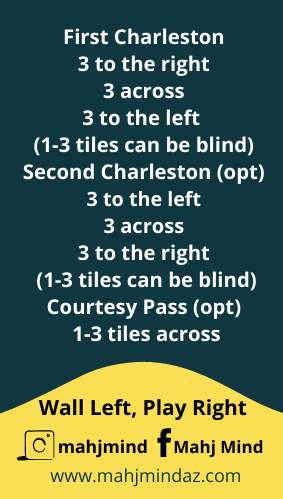
The Charleston consists of two rounds of tile passing. If you’re just getting started with American Mahjong or transitioning from online to in-person games, you’ll quickly learn that the Charleston is a vital and unique phase of the game. Each round includes three passes, during which you’ll pass three tiles to another player at your table:
First Round (Mandatory):
- Pass 3 tiles to the right
- Pass 3 tiles across the table
- Pass 3 tiles to the left (1 to 3 tiles may be blind)
This first round is compulsory for all players. No vote is needed to begin.
Second Round (Optional):
- Pass 3 tiles to the left
- Pass 3 tiles across the table
- Pass 3 tiles to the right (1 to 3 tiles may be blind)
This second round is optional. The decision to proceed must be unanimous. If even one player says, “Let’s stop,” then the second round does not occur.
It’s considered courteous to check in with the group after the first round, asking, “Do we want to continue?”
Charleston Etiquette and Courtesy
- Wait until all players have their incoming pass before passing the next set.
- While it’s not officially required, synchronized passing makes for a smoother experience.
- A common (though unofficial) custom: stack your three pass tiles in a pyramid formation for the first pass of the second Charleston.
Strategic Options During the Charleston
Though structured, the Charleston offers some wiggle room for strategy. Here are three advanced options you can use to your advantage:
1. Passing Blind
During the final pass of each round (first left, last right), you may pass tiles blind—without looking at what’s just been passed to you.
Why do this? If you’re happy with your hand and don’t want to disturb it, this lets you fulfill your passing obligation without breaking up potential combinations.
Warning: You must NOT peek at those tiles before choosing your pass. Doing so is considered cheating.
2. Stopping the Charleston
Any player can opt out of the second Charleston round. You don’t have to explain why—just say, “I may want to stop the Charleston,” before players look at their second left pass.
Strategically, stopping is wise if:
- You have a nearly complete hand.
- You don’t have three “expendable” tiles to pass.
If you’re still uncertain about your hand, continuing is usually the better move.
3. Courtesy Pass (Optional Across Pass)
After the second Charleston, you and the player opposite you may choose to make one final optional exchange.
- One player makes an offer of one to three tiles.
- The other can accept, counter, or decline.
- The number of tiles exchanged is determined by the player who wants to pass the fewest tiles.
Tip: If your opponent passed blind or declined the second Charleston round, they likely have a strong hand. You might want to decline their courtesy pass offer to avoid helping them.
Common Questions
Can I pass a Joker during the Charleston?
No. Jokers can never be passed during the Charleston. If you accidentally do, the receiving player must give it back immediately (NMJL Rule).
What if a player has the wrong number of tiles?
Before play begins, every player should have 13 tiles, and East has 14 (since East will discard first).
- If East hasn’t discarded and someone realizes they’re short one tile, that player may draw the missing tile from the wall.
- If a player is later found to have too many or too few tiles, another player may declare the hand dead. However, if a player realizes their own hand is dead, they should remain silent and continue playing defensively.
Pro Tip: Always count your tiles before the Charleston and again before East discards.
Final Thoughts: Make the Most of the Charleston
The Charleston is more than just an exchange of tiles—it’s an opportunity for interaction, observation, and strategy. Stay alert. Watch how others pass (or don’t). Use the Charleston to refine your hand, but also to read the table.
Remember: courtesy and strategy go hand in hand. Whether you’re playing with seasoned pros or at your first kitchen-table game, understanding and respecting the Charleston will make you a stronger and more gracious player.
Happy passing—and may the best hand win!
Source: Mah Jongg Made Easy (2024 pages 12-14)
Additional Reading
Stay Connected with Mahj Mind
Got a question or idea? Email us: MahjMind@gmail.com
Join the community: Mahj Mind AZ Facebook Group

Leave a comment