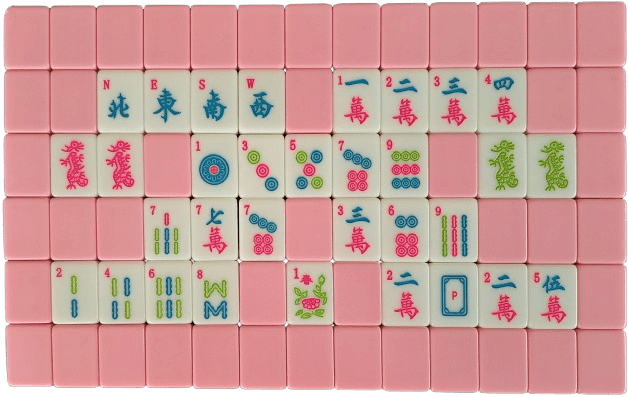
The National Mah Jongg League (NMJL) card outlines specific hands that players can make, and understanding the main categories will give you a solid foundation to build on and help you stay flexible during play. Let’s explore the categories on the card and how they shape your strategy and hand.
The Year Category
The Year category, which changes annually to reflect the current year uses number tiles that represent each digit. Because Mahjong tiles don’t include zero, the White Dragon or Soap serves as a stand-in for zero. For example, in 2025, your hand would include the tiles for 2, White Dragon (0), another 2, and 5. These tiles can be arranged as pairs, pungs (three of a kind), or other formations, often combined with flowers, winds, or dragons to complete the hand.
What makes the Year category particularly interesting is its flexibility. Depending on the tiles you draw, you might find opportunities to pivot to other categories such as Like Numbers, Consecutive Runs, or even 2-4-6-8 (evens) or Odds hands. For example, if you start aiming for 2025 but keep drawing 4s and 6s, it could make sense to switch gears and go for a consecutive run like 4-5-6 instead. Practicing with the card for the current year can be extremely helpful, allowing you to recognize patterns early and develop the adaptability necessary to succeed.
Like Numbers
The Like Numbers category features hands made up entirely of tiles bearing the same number, regardless of their suit. While the NMJL card may often illustrate these hands using the number 1, you’re free to use any number—whether that’s 2s, 5s, or 9s—as long as all number tiles match. The suits can vary unless the card specifies otherwise. These hands often include flowers or dragons, depending on the pattern listed.
Like Numbers hands are excellent for players who find themselves collecting multiples of a particular digit. They’re straightforward to identify early in the game and offer strategic flexibility—if your initial plan isn’t panning out, you can easily pivot to related categories like the Year or Consecutive Run hands. This makes Like Numbers a steady, dependable category for players who keep an eye on their tiles.
Math Play
The Math Play category adds a creative twist to American Mahjong. This category isn’t about performing arithmetic during the game but instead about recognizing tile combinations that follow simple math-themed concepts. For example, you might build a hand with tiles like 2s and 8s because 2 + 8 = 10, combined with tiles representing 1 and 0 (White Dragon for zero) to symbolize the total.
In past years, math play hands have used different target totals—like 7, 9, or 11—and occasionally involved multiplication or subtraction concepts. The key is to look for numerical relationships rather than solving equations.
Quints
The Quints category focuses on building hands with five identical tiles—a feat that’s only possible with the use of Jokers, since natural quints can’t be made and are impossible. Successfully completing a Quint hand typically requires starting with at least three Jokers and a strong set of multiples. Because these hands rely heavily on Jokers, they require careful planning and adaptability. If you’re dealt several matching tiles and multiple Jokers early in the game, pursuing a Quint can be a bold and rewarding strategy.
Odds
The Odds category focuses on odd-numbered tiles: 1, 3, 5, 7, and 9. Some hands use the full range of odds, while others concentrate on smaller subsets like “little odds” (1-3-5) or “big odds” (5-7-9). This breakdown offers players multiple flexible options for building hands, even if they don’t have every odd number available. Winds and Dragons often feature in these hands, increasing strategic possibilities.
One major advantage of Odds hands is the ability to pivot. If you start with odds but begin drawing even-numbered tiles, you can switch to related categories such as Consecutive Run or 3-6-9.
Winds & Dragons
The Winds & Dragons category centers on honor tiles—East, South, West, North, and the Red, Green, and White Dragons. These hands often include flowers and number tiles as well. Some patterns may mix winds with odd or even numbers, depending on the specific hand shown on the NMJL card. This category is a great option if you’re drawing a lot of honor tiles early in the game and aren’t finding a fit in the number-based categories. Be sure to watch how the winds and dragons pair with other tile types to complete these hands.
Singles and Pairs
The Singles and Pairs category is among the most challenging on the NMJL card because it doesn’t allow Jokers and relies entirely on singles and pairs to complete the hand. Because of its difficulty, these hands tend to carry higher point values.
Each Singles and Pairs hand corresponds to one of the main categories (Winds & Dragons, 2-4-6-8, Odds, Consecutive Run, etc.), allowing you to switch strategies mid-game if your Singles and Pairs hand becomes impossible to complete. This adaptability is crucial for players aiming to maximize their options throughout the game.
Conclusion
Each category offers challenges and opportunities. By studying the card and staying adaptable during play, you’ll develop the skills to switch tactics and improve your chances of winning. Embracing these categories and the strategies behind them will make your Mahjong experience more enjoyable and rewarding. So get your tiles ready, learn the patterns, and enjoy the challenge!
Additional Reading
Stay Connected with Mahj Mind
Got a question or idea? Email us: MahjMind@gmail.com
Join the community: Mahj Mind AZ Facebook Group

Leave a comment