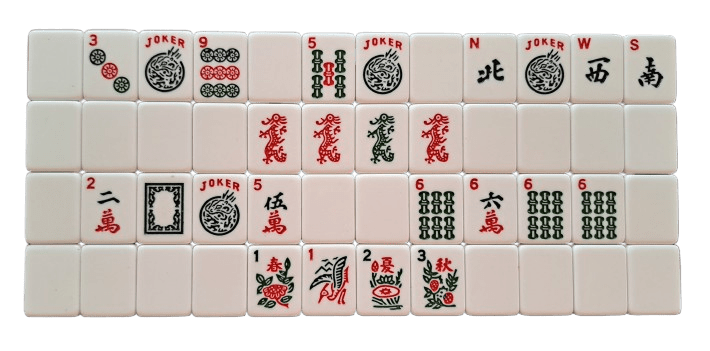
If you’re just starting out with American Mahjong, welcome! This fun tile game is a blend of strategy, memory, and social interaction — and yes, a bit of luck. While the card and rules can feel overwhelming at first, the learning curve smooths out with a little guidance and a lot of practice. Below are tips to help you improve your game and enjoy the journey.
Take In-Person Lessons
One of the best ways to learn American Mahjong is through in-person lessons. Our classes are designed for beginners who want hands-on experience, immediate feedback, and a chance to meet others in the community.
In-person lessons offer personalized attention—you’ll work with real tiles, learn through guided play, and have the chance to ask questions as they arise. Beyond technique, these sessions are a fun and social way to connect with others who are also learning or improving their game. Many players continue on to regular games with people they first met in lessons.
Want to join a class? or Book lessons
First Things First: It’s a Game
Let’s take some pressure off right away: in a four-player game, you’ll only win about one in four times — and that’s perfectly normal! Wins are great, but the real joy comes from playing, learning, and spending time with others. Celebrate your progress and congratulate your friends on their wins. Each game is a chance to learn and grow.
Know the Card
The most powerful tool you can have is a strong understanding of the National Mah Jongg League (NMJL) card. That little card tells you everything about what’s possible in a game for the year.
- Study the card, including the words in parentheses — they give clues about flexibility within hands.
- Try to learn hands in different categories so you can pivot easily if your tiles don’t work out for one. Did you know that each Singles and Pairs hand can be switched to the category for that hand? You may also be able to switch to consecutive numbers from one of the other categories.
- Look at the categories in the T zone- Consecutive Runs, 2468, 13579, or 369 are great places to start.
Know the Tiles
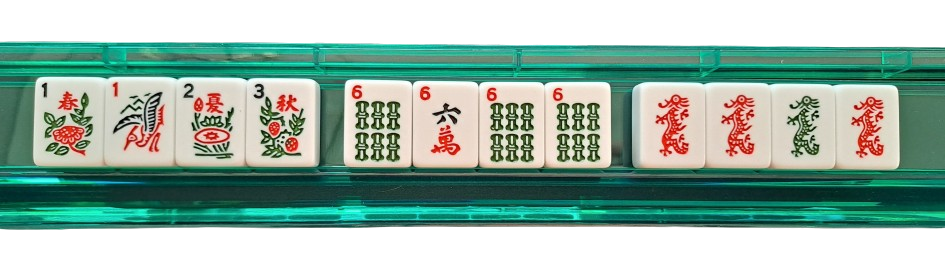
Different sets may look slightly different. Before you play with a new group, take a moment to familiarize yourself with:
- What do the flowers, jokers, dragons, and winds look like in that particular set?
- Familiarity with tile styles prevents mistakes and speeds up your play. For example, make sure you know the difference between suits and flowers and 1 bam birds.
Master the Charleston
The Charleston is the tile-passing phase at the beginning of each game. It’s your chance to shape your hand and get closer to a winning combination.
- Pick a category during the Charleston and then refine to a specific hand.
- Keep your hand open to possibilities, but try to focus your strategy based on the tiles you’re passed.
Learn the Lingo
Knowing basic Mahjong terms helps you follow gameplay and communicate confidently with others. Learn words like:
- Charleston (tile-passing round)
- Exposure or Meld (completed block of tiles)
- Joker exchange
- Don’t hesitate to ask fellow players to explain a term you don’t know as you go.
Understand Exposed vs. Concealed Hands
Exposed hands allow you to pick up discards to create exposures before you can declare Mahjong. Concealed hands require that you don’t use discarded tiles. You’ll have to draw all the tiles you need from the wall or during the Charleston. Concealed hands typically:
- Require no exposures.
- Can’t use discards (except for Mahjong itself).
- Tend to be more challenging, but often more rewarding.
Understand Joker Rules
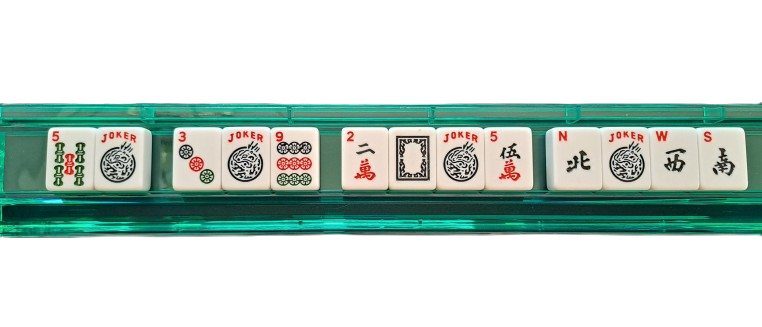
Jokers are powerful, but they come with rules:
- Jokers can never be used for pairs or singles, even if they’re grouped singles.
- You can exchange a joker from someone else’s exposure if you have the matching tile. This is a great strategy to gain more flexibility.
Dead Hands: What They Are and What to Do
In American Mahjong, a dead hand means the hand you’re building is no longer valid — but here’s the key:
You never call yourself dead. Only another player can declare your hand dead, and only under certain conditions.
Here are common reasons a hand may be declared dead:
- You have too many or too few tiles in your hand (should always have 13 or 14 when it’s your turn).
- Your exposures don’t match a valid hand on the NMJL card.
- You’re playing a concealed hand, but mistakenly call a tile to make an exposure (only Mahjong itself can be claimed on a concealed hand).
- You use a joker in a single or a pair, which is never allowed.
If your hand is called dead, simply stop playing and turn any jokers face down that were exposed at the time your hand was declared dead so others can’t claim them. Mistakes happen — even seasoned players slip up now and then.
Defensive Play: Know When to Switch Gears
Sometimes, especially toward the end of a game, you’ll realize that completing your hand is unlikely. This is where defensive play becomes key. Being a good Mahjong player isn’t just about winning — it’s also about smart defense when the odds aren’t in your favor. It shows skill, strategy, and consideration for the game as a whole.
Tips for how to play defensively:
- Avoid discarding tiles that might help opponents based on what they’ve exposed. Pay attention to their suits and patterns — don’t give them what they need to win!
- Jokers as discards, you can discard jokers and may be able to exchange for one from someone else’s exposure, and then discard that Joker.
- Aim for a wall game, rather than giving someone the winning tile.
Stay Flexible
Don’t lock into a hand too early. If it’s not working, don’t be afraid to try a different hand.
- Look at your tiles with fresh eyes after the Charleston.
- Hands that require multiples or pairs can be especially tricky, so plan accordingly and be ready to pivot.
Watch the Table
Improving at Mahjong isn’t just about focusing on your own tiles—it’s also about paying attention to the entire table. Watch what other players are discarding and consider whether any of those tiles could help your hand. Notice if someone is collecting a specific suit or building a certain pattern. Look for opportunities to exchange jokers from their exposures if you have the matching tile as it may increase your flexibility. Try to guess which category they might be playing.
Staying observant sharpens your strategy, helps you make smarter decisions, and reduces the risk of accidentally giving opponents the tiles they need to win.
Practice Online
Online platforms like I Love Mahj are excellent for reinforcing your Mahjong skills. I especially recommend this site because it includes an Exercise Room where you can practice making hands and working through the Charleston. If you use the code MAHJMIND, you’ll receive a 3-week free trial instead of the usual 2 weeks, and Mahj Mind will receive a small commission if you decide to make a purchase.
Tip:
- Choose your hand before using the suggested hands tool. This builds your confidence and decision-making.
Practice Exercise: Solo Mahjong
Want to improve on your own? Try this at-home solitaire-style practice:
- Shuffle your tiles and randomly draw 13 tiles.
- Choose a category or hand from the card.
- Simulate the Charleston by passing/discarding 3 tiles and redrawing. Make sure to omit jokers. Repeat for 6 rounds and do a courtesy round of one to three tiles with the discards.
- Pick and discard tiles one at a time, like in a real game.
- Keep going until you complete your chosen hand or decide to pivot to another.
- If stuck, check the NMJL card or the Mah Jongg Made Easy booklet.
Solo practice improves tile recognition, strategic thinking, and hand flexibility.
Final Words: It Will All Fall Into Place
American Mahjong is a lifelong game — one that gets more enjoyable the more you play. Don’t worry about mastering it all at once. With every game, you’ll grow more confident, more strategic, and more connected to the community around the table. So keep showing up, keep playing — and have fun doing it.
Continue reading to learn more.
Check out beginner-friendly videos like this YouTube channel for easy explanations.
Additional Reading
Stay Connected with Mahj Mind
Got a question or idea? Email us: MahjMind@gmail.com
Join the community: Mahj Mind AZ Facebook Group

Leave a comment