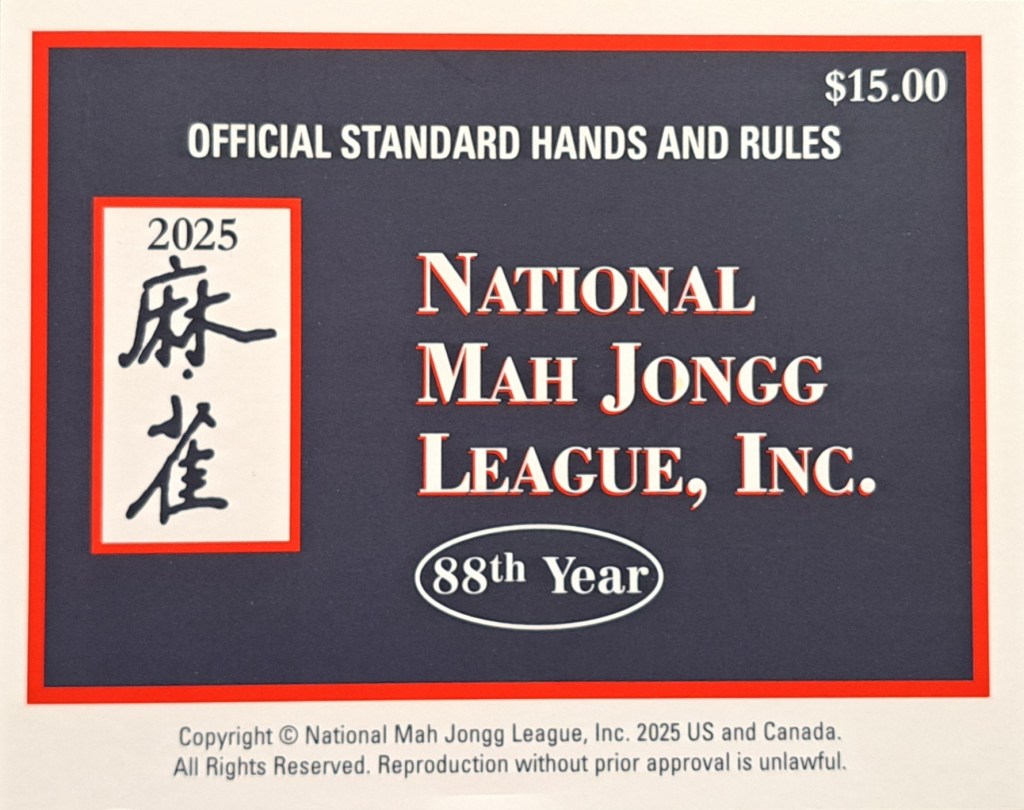
Whether you’re new to American Mah Jongg or refining your skills, two of the most important parts of your game are understanding which hands to play and knowing how to read the official National Mah Jongg League (NMJL) card.
This guide will walk you through choosing smarter starting hands, decoding the colors and symbols on the card, and understanding each category of hands so you can sit down with confidence at any table.
Tip #1: Avoid Starting with Harder Hands
Let’s start with one of the biggest traps newer players fall into: choosing harder hands too early.
What Makes a Hand “Hard”?
Harder hands usually require singles and pairs, and those tiles can’t be called (taken from another player’s discard). You can only draw them naturally, which makes these hands harder to complete, especially under pressure.
Avoid Hands with Lots of Singles and Pairs
Unless you already have the necessary singles or pairs in your rack by the end of the Charleston (the initial round of tile passing), it’s best to steer clear. The odds of drawing those tiles later are low.
Pro Tip: Stick with hands where you already hold solid components—especially pungs (sets of three) or pairs—and stay flexible during the early game.
Tip #2: Learn to Read the NMJL Card
Once you receive your annual Mah Jongg card from the National Mah Jongg League, it might look overwhelming, but don’t worry. Understanding the structure will help you build better hands and pivot when needed.
The Annual Mah Jongg Card
Each spring, the NMJL releases a new official card featuring updated hands to keep the game fresh and competitive. While the card changes each year, the rules and structure stay the same, so learning to read one card prepares you for all future versions.
Where to Buy:
- National Mah Jongg League
- Registered card collectors
Anatomy of the Card
The NMJL card is a tri-fold format:
- Front panel: Shows the year, blue for odd years (2025), red of even years (2024).
- Back panels: Includes basic rules, payouts, and joker rules
- Inside panels: Lists all playable hands, organized by category
Color Coding and Suits
This is one of the most misunderstood parts of the card:
Color ≠ Suit
- Green does not mean Bams
- Red does not mean Craks
- Blue does not mean Dots
What the Colors Actually Mean:
The color of a line on the card tells you how many suits must be used in a hand, not which suits.
- One color = One suit
- Two colors = Two suits
- Three colors = Three suits
You choose the suits based on your tiles. For example:
- A hand with red and green could mean Craks and Dots—or any other two suits.
Important: You control which suits to use, as long as you match the number of suits shown by the colors on the card.
Flowers and Winds Are Always Blue
On the card, Flowers and Winds are always shown in blue. They’re considered suit-neutral, meaning you can use them with any suit combination. Think of them as “wild” in terms of suit flexibility.
Understanding Categories on the Card
Each hand on the card fits into a category, and understanding these helps you strategize and pivot mid-game.
1. The Year
Uses a number pattern representing the year (e.g., 2025 = 2-0-2-5), combined with dragons, flowers, or winds.
2. 2-4-6-8
Uses only even-numbered tiles. If you’re drawing lots of even tiles, this is a strong starting category.
3. Like Numbers
Repeats the same number in various suits or forms. Any number can be used—not just 1s.
4. Math Play
Hands that resemble math equations, like 2 + 8 = 10 (using 2s, 8s, 1s, and 0s). Think of it as pattern-based rather than literal math.
5. Quints
Hands that require five of a kind, usually built with the help of jokers. It is recommended to start with at least three jokers if you’re going for a Quint hand.
6. Consecutive Run
Flexible and beginner-friendly; uses sequences like 1-2-3-4-5. This category is a reliable backup when you’re unsure of your direction or your tiles just aren’t cooperating.
7. 1-3-5-7-9 (Odds)
Uses odd-numbered tiles, sometimes mixed with winds, dragons, or flowers.
8. Winds and Dragons
Hands built around North, East, West, South, and dragon tiles. You may want to consider if you’re seeing lots of honor tiles early.
9. 3-6-9
Best for players with multiple 3s, 6s, or 9s already in hand.
10. Singles and Pairs
The toughest category—no jokers allowed. Only attempt if you naturally draw many pairs early in the game.
Read the Notes in Parentheses
Read the notes next to hands in parentheses that clarify requirements or offer flexibility.
Examples:
- “Any 3 suits” → You choose which suits
- “Any 4 consecutive numbers” → Doesn’t have to start at 1
- “Dragons: Any combination” → Pick the dragons based on your hand
Open vs. Concealed Hands (X vs. C)
- X (Open): You can claim discards to complete your hand
- C (Concealed): Must draw all tiles yourself, except the winning tile for Mah Jongg.
Concealed hands are harder but usually worth more points.
Scoring Overview
- 25 Points – Easier hands
- 30 Points – Slightly harder, often concealed
- 40–45 Points – Common with Quints or multiple pairs
- 50+ Points – Typically Singles and Pairs or specialty hands
Final Thoughts
Learning to read the American Mah Jongg card may seem overwhelming at first, but once you grasp the structure, categories, color coding, and suit flexibility, you’ll begin to see the logic behind every hand.
Key Takeaway: The rules don’t change much year to year—only the hands do. Master the structure, and you’ll always be ready to play.
Whether you’re a beginner or returning to the game after a break, focusing on easier hands and understanding the card is the surest way to improve your game and enjoy the rich strategy that American Mah Jongg has to offer.
Want more details?
Instruction Book “Mah Jongg Made Easy” Revised Edition 2024
Rules not in Mah Jongg Made Easy 2024
Stay Connected with Mahj Mind
Got a question or idea? Email us: MahjMind@gmail.com
Join the community: Mahj Mind AZ Facebook Group

Leave a comment