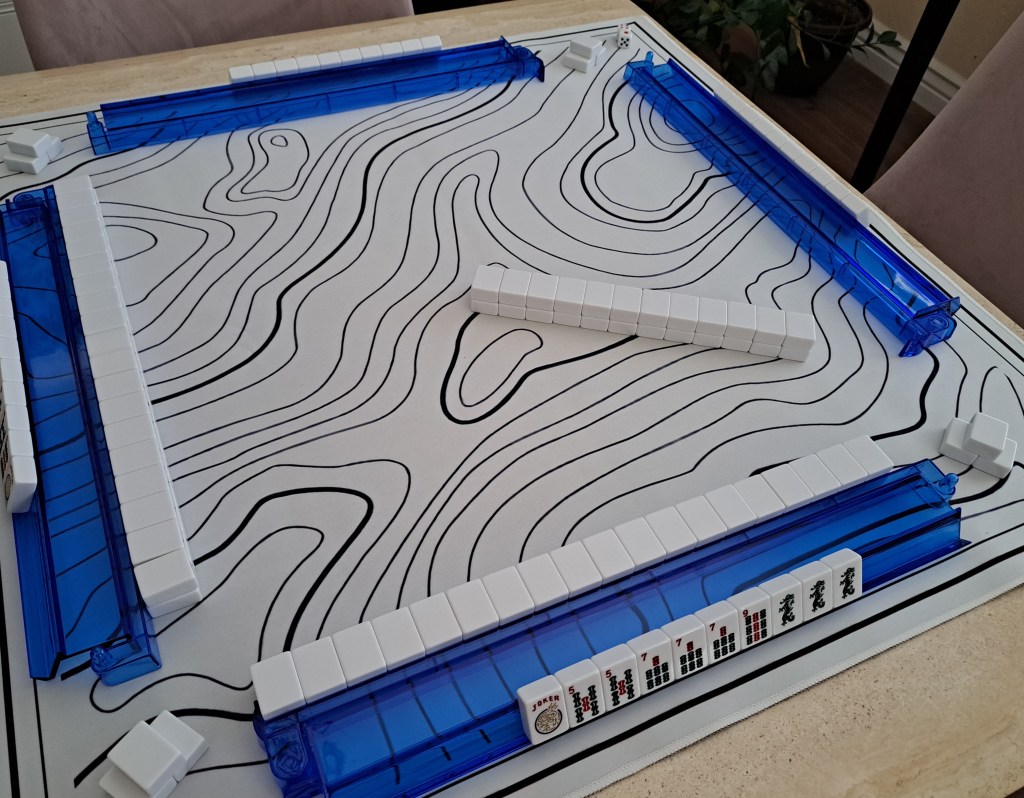
Build smarter hands from the start, adapt quickly, and sharpen your game with strategy and observation.
Why the Charleston Matters
The Charleston is a series of mandatory tile passes at the start of the game and sets the tone for your entire hand. It can feel chaotic, especially for new players, but with the right mindset and a little practice, it becomes a powerful opportunity.
Great Charleston decisions = stronger hands = more wins.
Know the Card, Not Just the Hands
Before making good decisions, you need to understand the structure of the Mah Jongg card:
- Learn the difference between fixed vs. flexible hands
- Understand categories: 2468, Consecutive Run, 369, Winds/Dragons, etc.
- Read the parentheses — they often clarify how a hand must be built
(Don’t skip this! Misreading them is a common cause of dead hands.)
Tip: You don’t need to memorize every hand, but you should recognize patterns and categories at a glance.
What Is the Charleston?
The Charleston consists of three rounds of tile exchanges between players. Its main purpose:
Build a stronger hand by collecting tiles that support a recognizable NMJL pattern.
Your goals during the Charleston:
- Identify your strongest direction
- Build around any multiples (pairs, pungs, kongs)
- Stay flexible and observe what others pass
Step-by-Step: How to Make Strong Charleston Decisions
| Step | What to Do | Why It Helps |
| Start with Your Multiples | Build around any pairs or pungs you start with | Multiples often form the core of winning hands |
| No Multiples? Find Your Strongest Suit or Category | Count suits, sequences, or categories you have the most tiles in | Narrow down your possible hand directions |
| Don’t Overcommit | Use early passes to gather possibilities | Flexibility gives you room to pivot later |
Let the Tiles Lead — Not Just Your Preferences
During the Charleston: Reorganize Often
Every time you receive tiles, rearrange your rack:
- By suit
- By number
- By card section
This can reveal new possibilities you hadn’t considered and identify spots where jokers could substitute effectively.
Even “junk” tiles should be racked first to avoid giving away visual “tells” that signal disinterest.
Think in Terms of Patterns and Overlap
- Don’t chase an exact hand too early.
- Focus on overlapping tiles that work in multiple sections.
- Consider year hands that use less-common combinations (e.g., 2 and 5 in 2025).
Strategy for 2025 NMJL Card
| If you have a lot of: | Look for hands in this category: |
| 2s and 5s | Year (2025) |
| Even numbers | 2 4 6 8 |
| Odd numbers | 1 3 5 7 9 Pick either 1-3-5 or 5-7-9 for clarity. |
| The same number | Like Numbers, Quints, or Consecutive Run |
| The same suit | Consecutive Run, (in evens) 2 4 6 8, or (in odds) 1 3 5 7 9 |
| Winds | Winds and dragons |
| 3s, 6s and 9s | 3 6 9 |
| 3 or more jokers | Quints |
| No jokers | Singles & pairs |
Don’t Judge Your Hand Too Early
Your first 13 or 14 tiles if you are East are just the beginning.
If you complete both Charlestons and the courtesy pass, you’ll see up to 21 new tiles!
Stay open to pivoting and reassessing direction based on new tiles.
Watch for Overlooked Hand Types
- Addition/multiplication hands are often skipped, but can be great pivot options. If your tiles don’t support a major category, don’t overlook these “backup” hands
Prioritize Pattern Compatibility
- Each tile in your hand should support a clear goal:
Ask yourself, “Does this tile move me closer to a valid hand from the card?” - Let go of “pretty” or uncommon tiles that don’t fit your strategy.
Keep your rack focused, flexible, and aligned with NMJL patterns.
Smart Pair Passing
- Don’t hang on to pairs that don’t help your hand.
Break them up early to free space and improve your passes.
Strategy: Observing What Others Pass
Charleston strategy isn’t just about your hand — it’s about reading the table.
Why Observation Matters
- Validate your hand direction
- Avoid passing helpful tiles to opponents
- Predict others’ categories and play defensively
Watch the “Two Lefts”
The two left passes from your right-hand opponent often reveal what they’ve ruled out:
- Entire suit passed = likely not playing that suit
- Winds/dragons = skipping special hands
- Rejected pairs
Reverse the First Right
Remember what you received in the first right?
If it’s unhelpful, consider passing it back on the first left — it’s strategic, cheeky, and allowed.
Read the Room: Reactions & Behavior
Facial expressions and reactions can reveal:
- Frustration = you blocked their direction
- Surprise or delight = you may have helped them
- Body language = “tells” about how good their pass was
Joker & Tile Value Strategy
- Save valuable tiles (flowers, dragons, winds) even if they don’t help yet as they may be used in joker exchanges.
- If your hand relies on pairs, and you have lots of jokers, consider switching to a more joker-friendly hand.
- Don’t cling to tiles just because they’re “rare” — stick to what works
Get Out of Your Comfort Zone
- Don’t play the same hands over and over.
- Try Quints, Singles & Pairs, or less common categories.
- Keeps opponents guessing and sharpens your overall skill set
Pro Tip: In casual play or online, challenge yourself to try a new category each game.
Discard Count After the Charleston: What It Tells You
| Discards After Charleston | Player Status | Risk Level | Strategy |
| 4+ or Between Hands | Underdog | Low | Play defensively |
| Exactly 4 | Contender | Moderate | Stay alert and open |
| Fewer than 4 | Front-runner | High | Push toward Mahjong |
Pick-and-Discard Phase: Stay Observant
Once the Charleston ends, the real game begins — but your attention should stay sharp.
Watch for:
- Frequent discards = unwanted suits or numbers
- Repeat discards = safe to pass
- Exposures = clues about opponents’ hand categories
If you’re not getting what you need, consider pivoting before it’s too late.
Practice Makes Progress
The more you play, the faster your decisions become. But you can accelerate improvement by:
Watching Charleston practice videos
Doing pattern recognition drills
Talking through your tile choices with other players
Final Takeaways: Smart Mah Jongg Strategy
✔️ Let the tiles guide you — not a fixed plan
✔️ Reorganize your hand frequently
✔️ Observe what others pass and expose
✔️ Stay flexible and ready to pivot
✔️ Practice regularly to sharpen instincts
With consistency, observation, and a flexible mindset, you’ll find Charleston decisions and your overall Mahjong game improving dramatically.
Stay Connected with Mahj Mind
Got a question or idea? Email us: MahjMind@gmail.com
Join the community: Mahj Mind AZ Facebook Group

Leave a comment