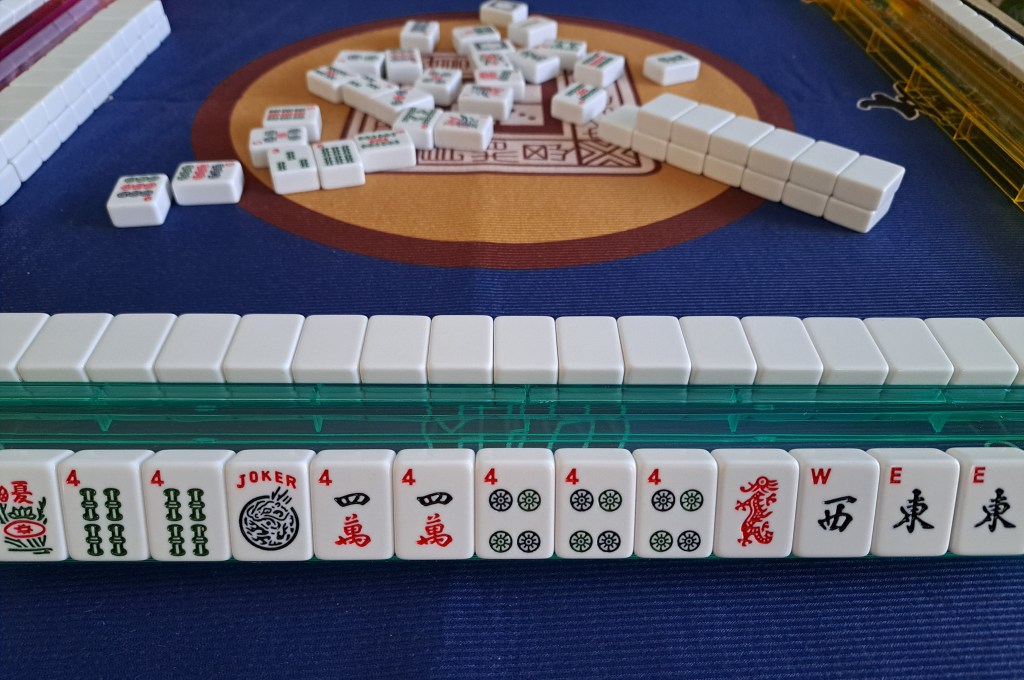
In American Mahjong, knowing how and when to switch hands is a powerful skill that separates advanced players from beginners. Even with a strong start, tile draws can go cold, critical pieces may be discarded, or another hand starts to form more naturally.
This guide will help you:
- Know when to switch Mahjong hands
- Evaluate your options with hand overlap strategy
- Practice switching at key game milestones
- Build confidence and reduce second-guessing mid-game
Why You Might Need to Switch Mahjong Hands
There are several common reasons to pivot during a game:
- Your hand has stalled — you’re not drawing helpful tiles.
- Critical tiles are being discarded or exposed.
- A better hand is forming naturally with new tiles.
- Charleston passes hint at a more promising category.
- You may even realize you’re playing a hand that doesn’t exist on the current year’s card.
Rather than stubbornly sticking to a failing hand, adapt your strategy based on drawn tiles, discards, and yours and other players’ exposures.
3 Key Factors for Switching Mahjong Hands
To switch successfully, consider these three critical decision-making elements:
1. Dependency
Are there other hands or categories that share similar tiles with the one you’re currently building? If two or more tiles from your current hand also work in another hand, you gain flexibility.
Ask: What other hands can I move to that use two or more of the tiles I already have?
2. Feasibility
Can the switch actually work, given what’s already been discarded or exposed on your rack and the racks of other players? Even if a hand is similar, it may not be feasible if key tiles are exposed or discarded.
Ask: Are the necessary tiles still in play?
3. Switchability
At your current game state, is this the right moment to switch? The further you are into the game, the more selective you need to be.
Ask: Do I have enough useful tiles and enough time to make the switch work now?
When to Switch: Game Stages
During the Charleston
- Watch what’s being passed: Are you seeing a lot of evens, odds, dragons, winds, or a predominant suit?
- Consider switching after the first or second left, when you have a clearer sense of what’s possible.
- Use your multiples or predominant suits to guide a new direction.
During the Game
Build your strongest option for the first 7–10 picks.
Reevaluate if:
- You see critical tiles in discards or opponent exposures
- Your hand isn’t progressing
With around 70 tiles left in the wall, it’s a strategic time to switch—it leaves enough time to rebuild.
Practice Makes Switching Easier: 3 Phased Exercises
Structured switching exercises build confidence:
Phase 1: After the First Left
- Begin with your strongest setup.
- After the first left pass, switch to a new category that still uses your base tiles (multiples, suits).
Phase 2: After the Charleston
- Use the full pass information to pivot to a better-fitting hand.
Phase 3: Mid-Game (~70 Tiles Left)
- Practice switching during gameplay when your hand stalls.
- Adapt based on what’s still available.
These phases teach:
- Pattern recognition
- Switching under pressure
- Strength-based decisions (not panic moves)
- Confidence to make informed pivots during real games
Example Scenarios for Switching Hands
1. From 2025 to Quints
- 2025 hand uses: 2s, 5s,Dragons, Flowers
- Quints hand uses: Any numbers, Winds, Flowers
Switch if: Your 2s or 5s are weak, but you hold flowers, winds, and multiple jokers, Quints may be a better fit.
2. From 2468 to Consecutive Run
- 2468 uses: Even numbers, Flowers, Dragons
- Consecutive Run uses: All numbers, Flowers, Dragons
Switch if: You’re drawing odd tiles or a number run is developing naturally.
3. From Any Like Numbers to Winds and Dragons
- Any Like Numbers hands use: 1–9, Flowers
- Winds & Dragons: Numbers 1–9, Dragons, Winds, Flowers
Switch if: draw winds that correspond with either odd or even numbers, and you can’t form the pungs or kongs needed in Any Like Numbers.
4. From 13579 to Winds and Dragons
- 13579: Odd numbers, Dragons, Flowers
Switch if: You start drawing Winds instead of the odds you need.
5. From 369 to Consecutive Run
- 369: 3s, 6s, 9s, Dragons, Flowers
Switch if: You’re pulling 1s, 2s, 4s, or 5s—perfect for a run hand.
When to Change Your Mahjong Hand (And When Not To)
Switching hands mid-game is one of the most strategic and sometimes necessary moves you can make in Mahjong. But timing is everything. Change too early, and you might abandon a viable hand. Wait too long, and you’ll run out of time to rebuild.
So when is the right time to switch?
Mid-Game is Prime Time for a Pivot
The middle of the game is your best window to evaluate whether your current hand is progressing or stalling. This is the moment to ask: Should I continue building or change direction?
If you’ve played wisely, you’ll have already considered a “Plan B” — a backup hand or category that uses many of the same tiles or patterns. That way, if your original hand doesn’t work out, you’re not starting over from scratch.
Signs You Need to Change Your Hand
Here’s how to recognize when it’s time to pivot:
- You’re stuck: No helpful tiles in multiple turns
- Your hand is blocked: Key tiles discarded or exposed
- Another hand is forming: A different pattern appears naturally
- Someone else might be playing your hand: Crucial tiles aren’t showing up at all
- You made an error: Exposed a concealed hand or playing a hand not on this year’s card
The Pivot Mindset: Think in Categories, Not Just Hands
Winning players think about categories, not just individual hands. Stay flexible by asking:
- What other hands use the tiles I already have?
- Can I shift without starting over?
- Is there a pattern forming that matches another category?
Push to Win or Play Defense?
If you’re one tile away from winning and your tile is likely still in the wall or will be discarded:
- Push for the win
- Discard your riskiest tiles first
If your chances are slim:
- Switch to defense mode
- Discard only safe tiles
- Don’t expose unless necessary — it reveals your strategy
- Use or discard jokers (they can’t be claimed)
Final Tip: Always Have a Backup Plan
Switching hands shouldn’t feel like failure, it’s a strategy.
By reviewing the mahjong card regularly and spotting overlapping tile groups, you can always keep a plan B in your pocket.
Over time, you’ll switch hands more confidently, with less stress—and more wins.
Additional Reading
Stay Connected with Mahj Mind
Got a question or idea? Email us: MahjMind@gmail.com
Join the community: Mahj Mind AZ Facebook Group
What’s Your Favorite Backup Hand?
When your original plan falls apart, what hand do you usually pivot to? Drop your go-to strategy in the comments — let’s learn from each other!

Leave a comment