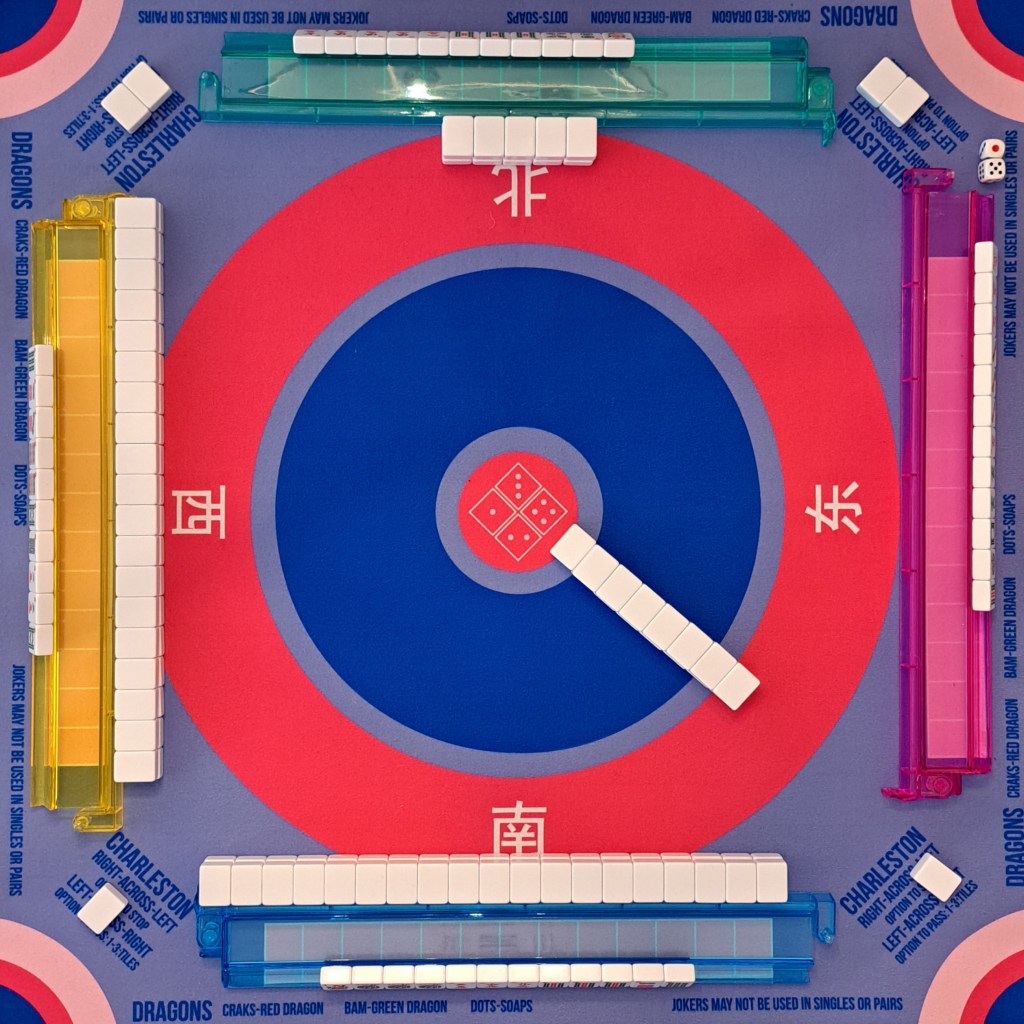
The Charleston is unique to American Mahjong, and within it lies a fascinating variation: the Blind Pass. While often a source of questions (and sometimes confusion), the Blind Pass is a legal option in certain rounds of the Charleston and adds both flexibility and strategy to the game.
In this guide, we’ll explain what a Blind Pass is, when it can be used, how the IOU system works, and what to do when all four players want to pass blind at the same time.
What Is a Blind Pass in Mahjong?
A Blind Pass happens when a player cannot—or chooses not to—pass three tiles during the first left or the last right of the Charleston. Instead, they may “steal” one, two, or all three tiles from their incoming pass and pass them along without looking.
- Players may pass 1, 2, or 3 tiles blind.
- The key is that these tiles must not be looked at before passing.
- While it’s courteous to say, “passing blind” so others know what’s happening, it is not a rule.
According to the National Mah Jongg League (NMJL), blind passes are permitted only during the first left and last right passes of the Charleston.
How the Blind Pass Works
- First Left: If you don’t want to part with three tiles, you may substitute one or more from the incoming pass and pass them on—without looking.
- Last Right: The same rule applies; you may “borrow” tiles from your incoming pass to complete your outgoing pass.
- No Peeking: Players may not look at blind tiles. While there is no NMJL penalty for peeking in social play, in tournaments this could result in penalties or being called dead.
NMJL clarification: “A blind pass may be made by passing one, two, or three tiles without looking at them. The League does not recommend a penalty for peeking, but players should be reminded that blind passes must not be looked at.”
The IOU System Explained
When players do not have enough tiles to pass, the IOU method allows the Charleston to continue smoothly.
- The player with the most tiles to pass begins.
- They pass what they can and say “I owe you” for the missing tiles.
- Once tiles cycle around the table, the player fulfills the IOU.
Examples of IOU in Action
- Example 1: Mixed choices
- One player has three tiles to pass.
- The others want to pass two and one blind.
- The player with three passes normally; others supplement with blind tiles.
- One player has three tiles to pass.
- Example 2: Everyone wants to pass two + one blind
- East passes two and gives South an IOU for one.
- Each player does the same.
- Once tiles come back, East fulfills the IOU, and the Charleston continues.
- East passes two and gives South an IOU for one.
- Example 3: Everyone wants to pass one + two blind
- East passes one and gives South an IOU for two.
- Others follow the same pattern.
- When East receives tiles from North, she pays off one IOU, then later fulfills the second.
- East passes one and gives South an IOU for two.
What If All Players Want to Blind Pass?
This is one of the most common questions about the Blind Pass. The NMJL recommends using the IOU system to resolve the impasse.
- The player with the greatest number of tiles to pass begins.
- She passes what she has and says, “I owe you.”
- Each subsequent player repeats the process until the Charleston circle is completed.
- Finally, the original IOUs are paid off, and all players end up having passed three tiles.
According to Mah Jongg Made Easy (2024, p. 13), “In the unlikely event that no one has a tile to pass, then the Charleston ceases and play begins.”
The Dealer’s Role in a Blind Pass
If the dealer isn’t declaring mah-jongg immediately after the Charleston, she’ll have to discard a tile to start the game. That means she actually does have at least one tile available to pass during the blind pass. Unless the table agrees to handle things differently, it’s usually the dealer who breaks the impasse. After all, the tile she’s holding might be her only chance at mah-jongg—so she’s in the best position to get the IOU process moving.
Blind Pass Etiquette
- Sneaking a peek: Looking at blind tiles is against the rules. While not penalized in casual play, it is poor etiquette.
- Stealing: Blind passing is sometimes described as “stealing” from the incoming pass. This is legal as long as tiles are not looked at.
- Communication: Saying “passing blind” is polite, though not mandatory. It helps prevent confusion at the table.
Final Thoughts
The Blind Pass adds flexibility to the Charleston and ensures that players aren’t forced to break up critical combinations too early. While it may seem confusing at first, the IOU system makes it possible for everyone to participate—even when no one wants to pass three tiles.
Key takeaways:
- Blind Pass allowed only on first left and last right.
- Pass 1, 2, or 3 tiles blind—without looking.
- Use the IOU method if players can’t fulfill their pass.
By mastering Blind Pass rules, you’ll keep the Charleston flowing and make your Mahjong games more enjoyable for everyone.
Sources:
Mah Jongg Made Easy (2024, p. 12, 13)
SLOPER ON MAH-JONGG Column #534
PASSING BLIND DURING THE CHARLESTON (Article 128)
Stay Connected with Mahj Mind
Got a question or idea? Email us: MahjMind@gmail.com
Join the community: Mahj Mind AZ Facebook Group

Leave a comment