What is a Dead Hand in American Mahjong?
A dead hand in American Mahjong refers to any hand that has been disqualified due to rule violations, making it impossible for that player to win the current game. Understanding dead hand rules is crucial for both beginners learning American Mahjong and experienced players who want to avoid costly mistakes that can end their chances of winning.
When a player realizes they have a dead hand, they may not declare that their hand is dead and should continue playing defensively for the remainder of the game or until another player declares the hand is dead.
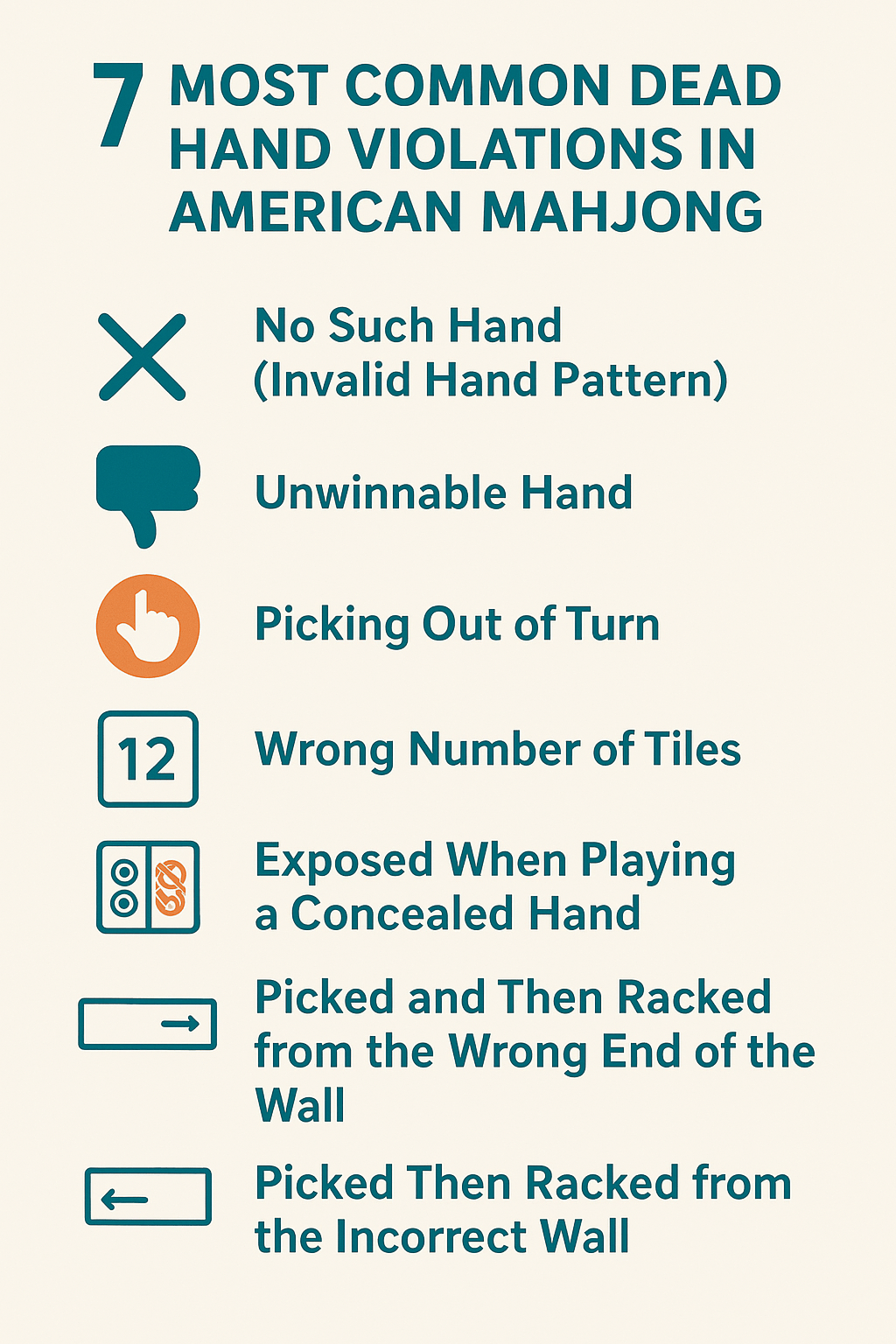
7 Most Common Dead Hand Violations in American Mahjong
1. No Such Hand (Invalid Hand Pattern)
What it means: Playing a hand pattern that doesn’t exist on the current National Mah Jongg League (NMJL) card.
Example: Trying to play a combination of tiles that looks like it should be a valid hand, but isn’t actually printed on the official card for that year.
How to avoid: Always double-check your chosen hand against the current NMJL card before exposing tiles or declaring Mahjong. The card changes annually, so patterns from previous years will no longer be valid.
2. Unwinnable Hand
What it means: Exposing tiles in a way that makes it mathematically impossible to complete any valid hand on the card.
Example: Exposing three flowers when your intended hand only allows for two, or exposing tiles that contradict the requirements of every possible hand you could make. Using a joker in a pair or with singles.
How to avoid: Plan your exposures carefully and ensure each exposure moves you closer to a specific, achievable hand pattern.
3. Picking Out of Turn
What it means: Taking a tile when it’s not your turn to pick, either from the wall or by calling for a discard.
Common scenarios:
- Picking from the wall before the previous player has fully completed their turn
- Taking your turn while another player is still deciding on an exposure
How to avoid: Always wait for clear confirmation that it’s your turn. Pay attention to the turn order and be patient during decision-making moments.
4. Wrong Number of Tiles
What it means: Having an incorrect number of tiles in your hand at any point during the game.
Most common causes:
- Having 14 tiles when you should have 13 (forgot to discard)
- Having 12 tiles when you should have 13 (discarded twice or picked incorrectly)
- Miscounting during exposures
How to avoid: Count your tiles regularly, especially after the Charleston or exposures. The standard is 13 tiles plus your pick, then discard to return to 13.
5. Exposed When Playing a Concealed Hand
What it means: Making any exposure (pung, kong, or quint) when attempting to play a hand marked as “concealed” on the NMJL card.
Key points:
- Concealed hands are marked with a “C” on the card.
- No tiles can be exposed for concealed hands – everything must be picked from the wall with the exception of calling for the last tile to Mahjong.
How to avoid: Identify concealed hands before you start playing and resist the temptation to call for tiles, no matter how helpful they might seem.
6. Picked and Then Racked from the Wrong End of the Wall
What it means: Taking tiles from the incorrect end of the wall during regular play.
American Mahjong wall rules:
- Tiles are picked from the end where the game began
- The wall moves to the left in a counterclockwise direction around the table
How to avoid: Pay attention to the designated wall direction and always pick from the correct end. When in doubt, ask the table for clarification.
7. Picked Then Racked from the Incorrect Wall
What it means: Taking tiles from the wrong player’s wall section.
Understanding wall ownership:
- Each player is responsible for pushing out their section of the wall
- Tiles must be picked from the correct directional sequence
- Wall breaks and direction must be followed properly
How to avoid: Keep track of which wall section is currently active for picking and follow the established direction of play with play to the right and walls to the left.
How Dead Hand Rules Are Enforced
Table Decision Process
When a potential dead hand violation occurs, the player may not declare their own hand dead. Another player may call the hand dead based on exposures and other discarded tiles.
Strategies to Avoid Dead Hands
Before the Game
- Study the current NMJL card thoroughly
- Identify concealed hands
- Refresh your knowledge of basic rules and procedures
During Play
- Count your tiles during the Charleston and after each discard
- Double-check hand patterns before exposing
- Pay attention to the turn order and wall direction
- Ask questions if you’re unsure about any rule
Dead Hand Prevention: Best Practices for American Mahjong Players
For Beginners:
- Focus on learning the categories in the T zone of the card
- Practice tile counting and hand recognition
- Play with patient, teaching-oriented groups initially
For Experienced Players:
- Stay current with annual card changes
- Help newer players avoid common mistakes
- Maintain consistent habits around tile counting and turn order
For Game Hosts:
- Establish clear house rules about dead hand enforcement
- Make sure players are using the current NMJL card
- Create a supportive environment for learning
Frequently Asked Questions About Dead Hands
Q: What happens to the tiles of a dead hand player? A: The exposures made before the player’s hand was declared dead stay in play for joker exchanges. Any exposures made that result in the hand being declared dead do not allow joker exchanges.
Q: Can you get a dead hand during the Charleston? A: No, dead hand penalties only apply during actual gameplay, not during the Charleston tile exchange. If a player has the incorrect number of tiles during the Charleston, all tiles are thrown back in, and the hand is redealt.
Conclusion: Mastering Dead Hand Rules
Understanding dead hand violations is essential for serious American Mahjong players. These rules maintain game integrity and ensure fair play for all participants. While the penalties may seem harsh, they encourage careful play and thorough knowledge of the game.
Remember, even experienced players occasionally face dead hand situations. The key is learning from these experiences and developing consistent habits that minimize the risk of violations. With practice and attention to detail, you’ll find that avoiding dead hands becomes second nature, allowing you to focus on strategy and enjoy the social aspects of this beloved game.
Respecting dead hand rules demonstrates good sportsmanship and helps maintain the rich traditions of American Mahjong.
Source:
Mah Jongg Made Easy pg. 14, 19-21
Stay Connected with Mahj Mind
Got a question or idea? Email us: MahjMind@gmail.com
Join the community: Mahj Mind AZ Facebook Group

Leave a comment