Introduction: Build with the End in Mind
One of the most important parts of any American Mahjong game happens before the first discard — during the Charleston and the beginning game. These early stages set the tone for everything that follows.
When you use the Charleston wisely, you can transform an average starting hand into something strong and focused by the time play begins. Think of this phase as your opportunity to build with the end in mind.
Let’s look at how to make the most of these crucial early moments.
Understanding the Three Phases of an American Mahjong Game
Before diving into Charleston strategy, it helps to understand the overall rhythm of a Mahjong round:
- The Charleston – Passing tiles to one another to improve and shape your hand.
- The Beginning Game – Starting after East discards the first tile; roughly the first seven picks from the wall.
- The Middle and End Game – Where you refine, defend, and (hopefully) declare Mahjong!
The Charleston is often where the biggest transformation happens. If you make smart decisions early, you’ll enter play only a few tiles away from a winning hand.
The Purpose of the Charleston: Hand Development
During the Charleston, you could see up to 21 new tiles through seven passes — the equivalent of 21 picks from the wall. That’s a powerful opportunity to refine your hand before the game even begins.
Because every player passes differently — some defensively, some generously — treat every pass as a chance to gather tiles that strengthen your direction.
The goal? Expedite your hand development so you begin play with purpose.
Step 1: Identify the Strength of Your Hand
When you first look at your dealt hand, resist the urge to lock into a specific hand right away. Instead, identify your strongest category — the group of hands that uses the most of your tiles.
You might see strong even numbers, several bams, or pairs in consecutive numbers. Staying at the category level (like Evens, 369, or Consecutive Runs) keeps you flexible while you’re still passing. You don’t need to pick a final hand until most — if not all — of your discards are gone.
Tip: Don’t rush. During the Charleston, your goal isn’t perfection — it’s progress. Keep what fits your chosen category, pass what doesn’t, and let the tiles guide your direction.
How to Analyze Your Starting Hand
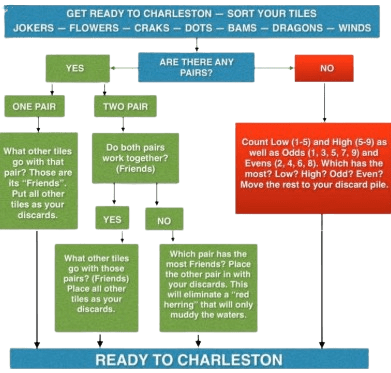
1. Count your Jokers.
If you have no jokers, keep Singles and Pairs in mind. If you have two or more, consider Quints as an option.
2. Identify Pairs (and Multiples).
Organize your tiles and look for pairs or pungs. These are the backbone of most hands. Also note any useful single groupings (like 2025, NEWS, or 10).
3. Look for Complementary Tiles
Pairs (or groups) that work well together on the card are your “friends.” If two or more pairs fit within the same family of hands, that’s a strong direction to pursue.
4. Assess High vs. Low.
Count your low tiles (1–5) and high tiles (5–9). This can help you identify consecutive runs or other patterns in 13579.
5. Assess Odd vs. Even.
Compare your odd-numbered and even-numbered tiles. A clear imbalance often signals the best direction to follow.
If you still don’t have clarity, pass three safe tiles — and stay flexible for the next round.
Step 2: Optimize by Targeting Multiples
Every hand on the NMJL card includes multiples — pairs, pungs, or kongs.
Your goal in this phase is to optimize by identifying and protecting them.
If you’re lucky enough to start with a pung or kong, explore how to make it fit into one or more categories. If you have pairs, build around them. Multiples are your anchors; everything else can shift.
Step 3: Gather and Stay Flexible
As you pass during the Charleston, keep what fits your chosen category — but be open to pivots. Sometimes a pass from another player will introduce a new opportunity you didn’t anticipate.
And one more tip: keep your flowers!
Flowers are used in many hands and can become valuable later, even if they don’t fit your current plan. Wait until you are sure of your hand to discard flowers.
Step 4: Solidify During the Beginning Game
Once East discards and the game officially begins, you’ll have around eight picks (the short first wall) to confirm your direction.
During this “beginning game” phase, ask yourself:
- What’s working best with the tiles I’ve kept?
- Does my category still make sense?
- Are there opportunities to pivot based on early discards?
By the time you reach the middle game, your goal is to have a clear vision of your target hand — and a plan to get there.
Final Thoughts: Build with the End in Mind
American Mahjong is a game of transformation, and the Charleston is where that transformation begins.
By optimizing your multiples, focusing on a strong category, and using the first few turns of play to confirm your direction, you set yourself up for success.
The Charleston is your hand’s foundation — build it wisely, and stay flexible as it grows.
Sources:
Sloperama Four-Step strategy for the Charleston
HOW TO PICK A HAND (Article 183)
Stay Connected with Mahj Mind
Got a question or idea? Email us: MahjMind@gmail.com
Join the community: Mahj Mind AZ Facebook Group

Leave a comment