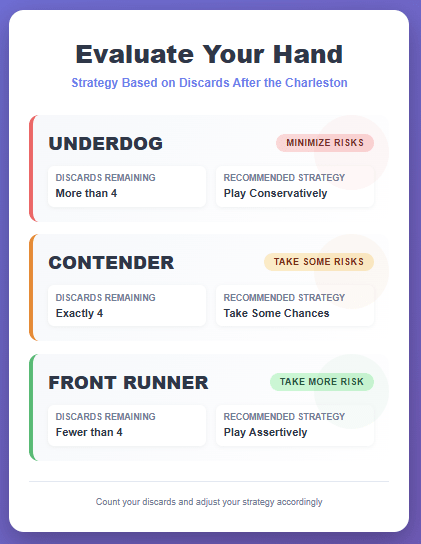
The Power of Post-Charleston Strategy
Once the Charleston ends and the game begins, your tiles tell a story. The choices you made while passing shape what’s possible next. This stage right after the Charleston, is where smart strategy can transform an average hand into a winning one.
Not every game begins with promise. Sometimes you’ll end the Charleston without a clear direction, holding a mix of tiles that don’t seem to fit anywhere. It’s natural to feel frustrated or tempted to force a hand, but seasoned players know that success comes from adapting to what’s in front of you.
Adapting isn’t about lowering your expectations; it’s about sharpening flexibility, defense, and patience. Playing wisely from a weak position is just as valuable as capitalizing on a strong one.
Step 1: Evaluate Your Position After the Charleston
After the Charleston, count your discards—tiles that don’t fit your developing plan. This simple check helps you determine your position and the amount of risk you can safely take as play begins.
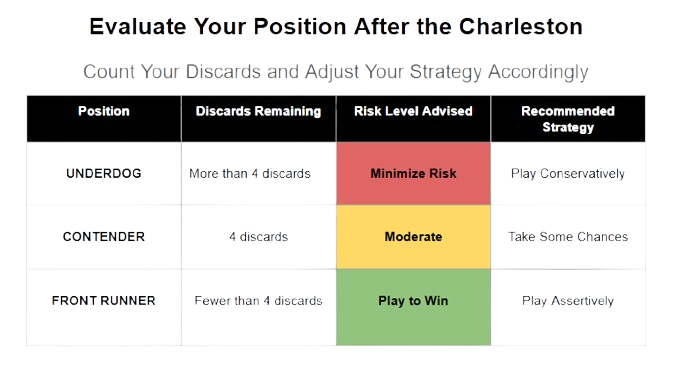
Your position isn’t permanent; it can (and should) change as you draw new tiles and watch what others discard will shift your focus. Keep reassessing throughout the game.
Step 2: Build Your Mindset
A big part of playing well after the Charleston isn’t just strategy, it’s mindset. Your emotional response can influence your decisions at the table.
Mindset Reflections
- Do you see a weak start as a setback or as a chance to sharpen your defensive play?
- How do you respond to too many discards?
- What is in your control?
A weak start doesn’t define the game; it defines your opportunity to grow. Every hand is a chance to practice resilience, refine your strategy, and strengthen your confidence.
Step 3: Strategy by Standing
Your position determines not only your mindset, but also how you play.
If You’re an Underdog (More than 4 Discards)
You’re starting from behind—but don’t panic.
This is your time to play defensively and flexibly.
- Avoid risky exposures early.
- Keep multiple category options open.
- Practice safe discards and patience.
Mindset Shift:
A weak start isn’t failure—it’s training. Many underdog hands become surprise wins simply because the player stayed adaptable and calm.
If You’re a Contender (4 Discards)
You’re in a solid position with room to grow.
- Take moderate risks, call a discard if it strengthens a key block.
- Watch for gaps or weaknesses (like needing a pair where you only have a single).
- Reassess after each pick: are your discards shrinking or growing?
This is your chance to gather smartly and prepare to move into front-runner territory.
If You’re a Contender (4 Discards)
You’re ahead of the pack, lean into it!
- Be assertive and claim discards that move you toward a win.
- Play confidently but watch opponent exposures and discards.
Your strong start gives you momentum. Use it to set the pace of the game.
Step 4: Evaluate Weaknesses and Gaps
Even strong hands have vulnerabilities. Recognizing them early helps you make smart choices about when (or if) to make exposures.
Gaps: Missing key numbers or tiles (e.g., no 3s in a 3–6–9 hand).
Weaknesses: When you need a pung or kong, but only have singles or pairs.
Before claiming a discard, ask yourself:
- Do I have gaps in my pattern?
- Can I fill them naturally or with jokers?
- Am I locking into a hand too soon?
If your hand has major gaps, wait. Sometimes, pivoting to a different category (e.g., from 3–6–9 to Consecutive Run) can save your hand and extend your chances.
Step 5: Adapt to the Game Phase
Early Game (After the Charleston)
Stay at the category level, not the specific hand level.
- Stay flexible and observe the table.
- Keep tiles that work in the category you have chosen.
- Watch what others are exposing; it gives clues about which tiles are safe to discard.
After about seven picks, reassess your position:
- Have you formed new multiples or filled gaps?
- Has your position changed (underdog → contender → front runner)?
Mid-Game and Beyond
If your hand isn’t progressing by the time about 70 tiles remain in the wall, it may be time to switch.
- Transition from a difficult hand to an easier one.
- Move from a concealed hand to an exposed one.
- Or, if you’re in a strong position, press confidently toward Mahjong.
Step 6: Recognize Red Flags
Be alert for opponent behavior that signals danger or opportunity:
During the Charleston:
- Opponents passing blind or negotiating low (may indicate defensive play).
- Someone stopping the Charleston early (often confident hand).
During Play:
- Opponents making exposures early (indicates strong development).
- Opponents discarding jokers (possible Singles & Pairs hand).
Use these signs to adjust your play. Defensive play may be your best strategy when others are strong, and you are an underdog.
Final Thoughts: Trust the Process
Mahjong is a game of transformation. Each Charleston and wall offers a new chance to grow your hand and your confidence.
By adjusting your strategy based on your standing and staying aware of your gaps, weaknesses, and opportunities, you’ll learn to read your hand clearly, play with purpose, and enjoy every round whether you win or lose.
You don’t need to play perfectly to have fun. In every game, at least three out of four players won’t declare Mahjong, so celebrate progress, not just wins.
Sources:
https://mahjlife.com/wiki/how-to-adapt-after-a-tough-charleston-article-266/
https://mahjlife.com/wiki/hoptois-core-strategy-by-wall-article-116/
Stay Connected with Mahj Mind
Got a question or idea? Email us: MahjMind@gmail.com
Join the community: Mahj Mind AZ Facebook Group

Leave a comment