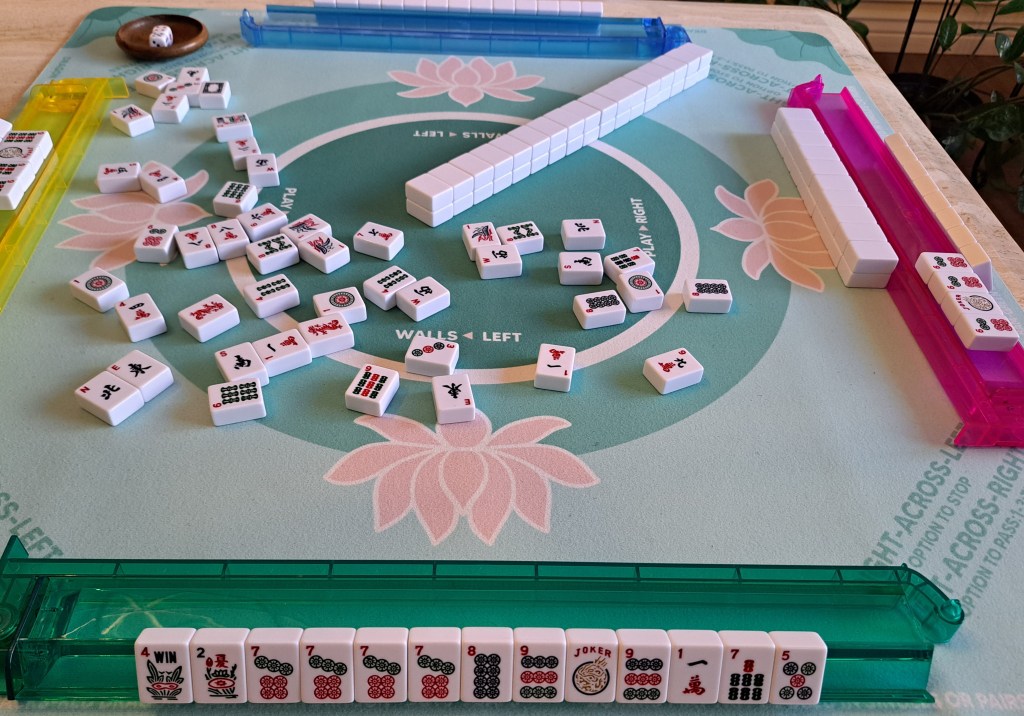
The middle game in American Mahjong happens when drawing from the third wall (tiles 40–80) and is where decisions become critical. By this point, the Charleston is complete, opening discards are out, and the table begins to reveal patterns. The middle game is when smart observation, timing, and flexibility separate strong players from the rest.
Understanding Middle Game Fundamentals
Shift Your Focus: From Building to Reading the Table
By the middle of the game, pay as much attention to what others are doing as to your own hand.
Key observation points:
- Observe discards and exposures. You can often identify an opponent’s possible category (2468, 369, or Winds/Dragons) from just one set of exposed tiles, and their probable hand from two sets.
- Track post-exposure discards. What someone discards after making an exposure may provide crucial clues about their hand.
- Commit strategically. Choose your category by the end of the second wall, and commit to a single hand by the end of the third wall.
Effective Joker Bait Tactics:
- If you have multiple discards, keep pairs even if you don’t immediately need them, as they serve as excellent “joker bait”
- Redeem jokers whenever possible – When someone exposes a joker, exchange it with your matching tile, even if you can’t use it immediately
- This prevents opponents from redeeming jokers later and gives you safe discards
- Consider leaving one joker in an opponent’s exposure to avoid paying for a jokerless hand
Pro tip: The ideal time to discard bait tiles is around the middle game (approximately 70 tiles remaining).
Reading the Table: Red Flags and Warning Signs
Critical Indicators to Watch
Certain actions should immediately heighten your awareness:
Multiple exposures by one opponent
- Their hand may be nearly complete
- Switch to defensive discarding
Opponent discards a joker
- Often signals they’re waiting on a tile for a single or pair.
- They’re likely very close to Mahjong
These cues should make you play more cautiously with discards.
Mid-Game Strategy Breakdown
1. Pick the Right Discards to Claim
Early in the game, you want to stay concealed and flexible. But by mid-game, it’s time to start picking tiles you need — especially when you have seven or more tiles needed for Mahjong.
- Track how many of your needed tiles have been discarded.
- Consider exposing when it brings you significantly closer to your goal.
- Remember: Two or more exposures make your hand visible to others; balance that risk carefully.
2. Smart Discarding Tactics
As the game progresses, the risk of feeding an opponent increases.
- One exposure: Opponent may still be developing
- Two exposures: Assume they’re close to Mahjong
Before discarding, check the table:
- No matching tiles visible? Higher risk—someone may need it
- Two or more already out? Safer bet
- Flowers and dragons: Discard sooner rather than later, especially in the 2025 NMJL card, where dragons appear as pairs and singles, and flowers can be pairs.
3. Knowing When (and How) to Change Hands
The middle game is the best opportunity to change hands if your current plan isn’t working. By this stage, you’ve seen enough of the wall and table to make an informed decision, but still have time to rebuild.
Good reasons to switch:
- Your key tiles are showing up in other players’ discards or exposures.
- Too many of your essential tiles have already been discarded.
- You realize your chosen hand isn’t viable (or was based on a misread of the card).
Bad reasons to switch:
- Frustration, impatience, or indecision
- Switch once if needed—not repeatedly—or you’ll lose focus and momentum.
Example Scenario: When to Abandon a Hand
You’re building FFFF 1111 22 3333 in one suit, dots, using 7, 8, and 9. You need a pair of 8s, but two have been discarded, and another player exposed 6 Dots.
Analysis: Changing to a 6–7–8 pattern won’t work, and switching to line 2 in Consecutive Run isn’t viable.
Solution: Check for Like Numbers or 13579 possibilities. If nothing aligns, shift to defensive play and aim for a wall game.
Concealing Your Hand
Keeping your intentions hidden is essential. The longer you can conceal your hand, the greater your chances of success.
Tips for strong concealment:
- Maintain a poker face. Don’t show excitement or frustration.
- Vary your discards. Mix suits and numbers to make it harder for others to read your pattern.
- Delay exposures when possible to avoid giving away your direction prematurely.
- Stay unpredictable. Sometimes, appearing to struggle keeps others guessing.
Even with a strong starting hand, acting nonchalant can work to your advantage.
Defensive Play: Reading the Discard Pile
Your opponents’ discards are constant clues.
- Track which suits and numbers they’re letting go of.
- Look for patterns: multiple evens, no dots, or recurring winds.
- If an opponent appears close to Mahjong and your hand is weak, switch to defense.
- Discard only “safe” tiles, ones already visible on the table either as exposures or discards.
Key Takeaways for a Strong Middle Game
- Observe constantly — the table tells the story.
- Commit gradually: category by wall, hand by midgame.
- Use jokers and bait strategically; timing is key.
- Reassess and pivot if needed.
- Conceal your hand as long as possible.
- Adapt to your opponents’ style, not just your tiles.
When you reach the middle of the middle game, you’re not just playing tiles — you’re playing people. Observation, timing, and self-control are your strongest allies on the path to Mahjong.
Sources:
HOPTOI’S CORE STRATEGY BY WALL (Article 116) – Mahj Life
Mahj Life: Joker Bait Strategy
The Complete Guide to American Mah Jongg Strategy | I Love Mahj
Stay Connected with Mahj Mind
Got a question or idea? Email us: MahjMind@gmail.com
Join the community: Mahj Mind AZ Facebook Group
What’s YOUR biggest middle-game challenge? Tell us in the comments!

Leave a comment