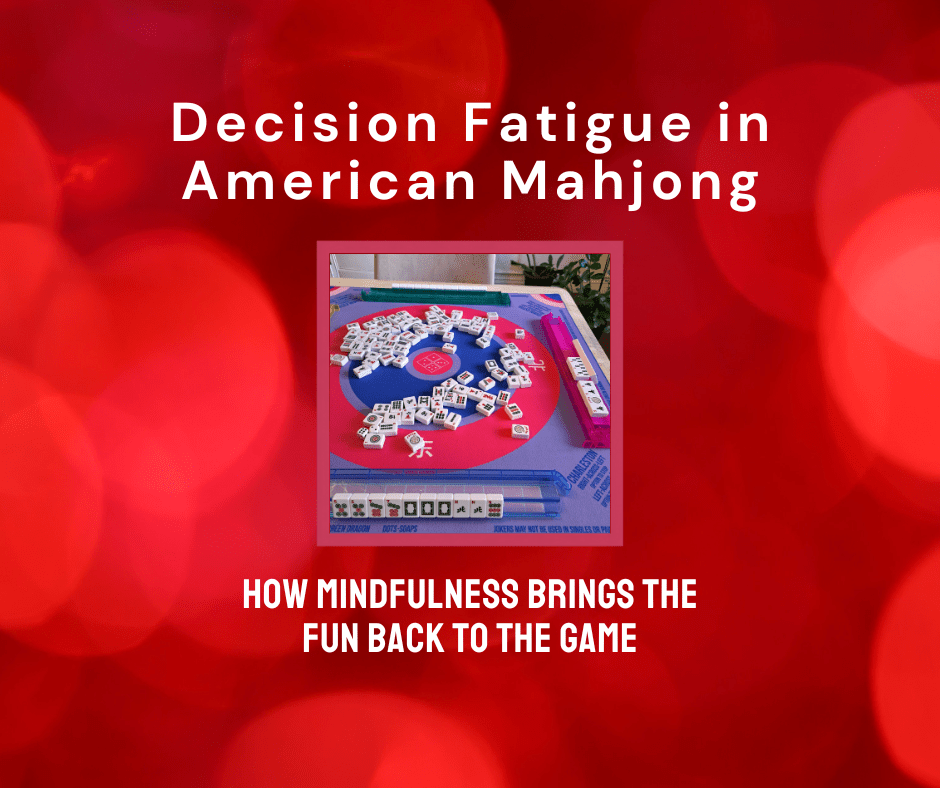
Have you ever found yourself deep into an American Mahjong session, staring at your tiles, when suddenly every decision feels heavy?
Your mind feels foggy. The joy is draining from the game. You start second-guessing every pick and discard, and your once-clear strategy now feels like a game of whack-a-mole.
Welcome to decision fatigue in mahjong, the quiet companion at almost every table.
American Mahjong asks a lot of our brains. We’re constantly evaluating hands, tracking discards, reading exposures, watching jokers, and adapting on the fly. That mental load adds up.
At Mahj Mind, we believe mindfulness is your secret weapon. When decision fatigue shows up, it’s time to recognize, release, and respond.
Let’s walk through how.
Step One: Recognize Decision Fatigue
The first step is simply noticing what’s happening.
Decision fatigue often shows up as:
- Feeling stuck on a hand with no clear path forward
- Looping through the same options over and over
- Losing confidence in choices that usually feel easy
- Feeling irritated, rushed, or disconnected from the game
Here’s the truth every mahjong player needs to hear:
Your best looks different on different days.
Some days, you see patterns instantly and pivot like a pro. Other days, even simple decisions feel hard. Both are completely normal.
Your focus naturally rises and falls during play. Some players warm up slowly. Others start strong and fade later. There’s no “right” rhythm; the key is recognizing your own patterns and offering yourself grace.
Recognition alone is powerful. Once you name decision fatigue, you stop fighting it.
Step Two: Release the Pressure
When you notice you’re stuck, it’s time to release, not from the game, but from the internal pressure.
Try a Micro Reset
Between turns, gently shift your attention:
- Look around the room.
- Notice the artwork on the walls.
- Glance out the window.
- Observe something you hadn’t noticed before.
This isn’t a distraction. It’s a mindful pause that gives your nervous system a moment to regroup and invites a fresh perspective.
Between games, take a real break:
- Grab water or a snack
- Stretch your legs
- Change seats if you’ve just dealt as East and there is another table to move to.
- Step away for a bathroom break
These small acts of self-care help clear mental clutter and restore focus.
Remember: stepping back for a moment often helps you move forward with clarity.
Step Three: Respond with Intention
Once you’ve recognized and released, it’s time to respond thoughtfully and strategically.
When nothing feels clear, use this simple framework.
1. Pause and Assess Potential
Based on discards and exposures, which hand has the most realistic chance of completion?
You’re not searching for perfection. You’re choosing the most promising path with the information you have right now.
That’s mindful decision-making in mahjong.
2. Count Your Multiples
When torn between hands, notice which option uses more of your pairs and pungs.
Tiles that already work together usually offer a smoother road forward.
3. Consider What’s Still Out There
You don’t need perfect tile tracking.
Even general awareness helps:
- “I’ve seen a lot of winds.”
- “No one seems to be discarding dragons.”
This big-picture view supports smarter, calmer choices.
The Good, Better, Best Mahjong Mindset
At Mahj Mind, we love this approach: think good, better, best; not right or wrong.
Make the best choice you can with what you know. Commit to it.
If new information arises and your plan no longer makes sense, allow yourself to pivot once, either to your second option or to defensive play.
And remember this important truth:
Playing well does not always equal winning.
You can make smart decisions, follow sound American Mahjong strategy, and still not make mahjong. That’s part of the beauty of mahjong: strategy and luck are always in the mix.
Sometimes, the best move is defense: protecting yourself from feeding someone else’s hand rather than chasing your own. That’s skill. That’s wisdom. That’s mahjong.
Moving Forward with Mindfulness
Decision fatigue in American Mahjong isn’t a weakness. It’s a natural response to a dynamic, mentally demanding game that asks us to continue to evaluate and re-evaluate.
When it shows up, come back to the Mahj Mind basics:
- Recognize what you’re feeling
- Release the pressure with small, mindful pauses
- Respond with intention and strategy
You don’t need to play perfectly.
You just need to play thoughtfully and kindly toward yourself.
The tiles will fall as they will. Your job is to make the best decision you can with what you know right now… and then let it go.
That’s the heart of mindful mahjong.
Sources: Mastering the Art of Teaching Mindfulness in the Classroom
What helps you when decision fatigue hits during your mahjong games?
We’d love to hear your strategies — share in the comments below.
Stay Connected with Mahj Mind
Email us: MahjMind@gmail.com
Join the community: Mahj Mind AZ Facebook Group

Leave a comment