Discards in American Mahjong: How to Use Them, When to Claim, and When It’s Too Late
Once the Charleston is complete, you move into the pick-and-discard phase. This is where strategy sharpens, and each tile matters more. And at the center of it all? The discard.
If you have gaps or you’re still getting your footing after the Charleston, don’t worry. This phase gives you a chance to recover, adapt, and refine your plan. With each turn, you’ll draw a new tile and make a decision: what to keep and what to let go.
Let’s break down exactly how discards work — how to make them, how to claim them, and what makes a discard no longer available.
Turn Structure: Pick and Discard
After the Charleston, players take turns moving counterclockwise around the table.
Each turn consists of:
- Picking a tile from the wall.
- Rack the tile by placing it on the sloped part of your rack.
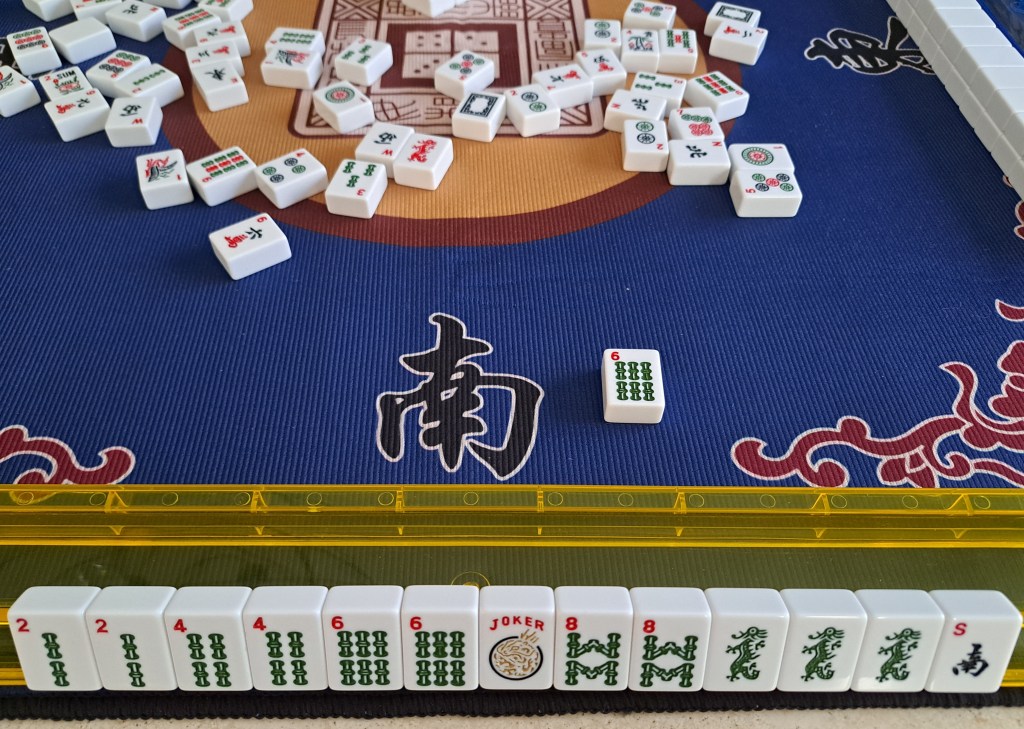
- Discarding one tile by placing it on the table and naming it aloud (e.g., “8 Bam”).
Tip: You should rack the tile before looking at it. This ensures that other players do not get a glimpse of your tile.
What Makes a Tile Officially Discarded?
A tile becomes a discard when either of these two things happens:
- It touches the tabletop.
- It is fully named aloud e.g., “6 Dot”. (A player may change their mind if they only say “6” and the tile has not touched the table.)
Once either of those occurs, the tile can be claimed — but only for a short time.
The Window to Claim a Discard
You can claim a discard up until the next player racks their drawn tile. Once that happens, the window of opportunity is closed.
Let’s be specific:
- Tapping a tile or picking it up is NOT the same as racking.
- The tile must be placed on the slope of the rack — that’s racking, and it ends the opportunity for other players to claim the previous discard.
In friendly games, especially with new players, it’s kind to give a short pause — maybe a silent three-count — before drawing your tile. In faster games, the pause can be briefer, allowing time for the previous player to pull their hand back from the center.
How to Claim a Discard
To claim a discard, say clearly:
- “Call!”
- “Take!”
- “I’ll take that!”
- Or even, “Hold!” (as long as you speak before the next tile is racked)
Say it before the next tile is racked.
If more than one player wants the tile, it goes to the next in turn order, unless someone is calling it to declare Mahjong, which always takes priority.
Rules for Making a Claim
You may only claim a discard if it completes a valid meld (or “block”) for your hand. That means:
- Three of a kind (pung)
- Four of a kind (kong)
- Pair or single — only if used to declare Mahjong
Concealed hands cannot call any discards — unless it’s the final tile for Mahjong.
To complete a claim:
- Say “Call” before the next player racks.
- Place the claimed tile with matching tiles (or jokers) on top of your rack, not on the sloped part.
- Place the claimed tile with the matching tiles or jokers to form a valid meld.
- Finish your turn by discarding a tile from your hand.
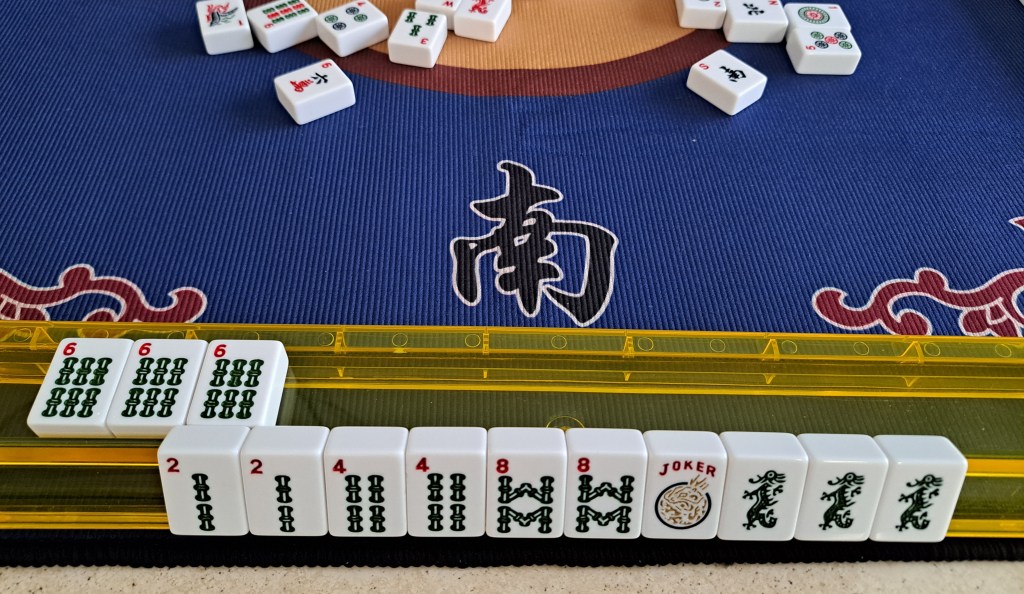
You may adjust the tiles in your exposure until you discard — after that, no changes.
Any player can call a discard. Once they do and make their own discard, play keeps going to the right. This can mix up the turn order and some players might get skipped, but it usually balances out in the long run.
When You Can No Longer Claim a Discard
You can no longer claim a discard once:
- The next player has racked their tile.
- The next player declares Mahjong.
- A new discard has been made.
Once a tile is officially dead, there are no second chances to go back. So, pay attention, and speak quickly but clearly if you intend to call.
Discard Strategy: Playing Offense and Defense
In early turns, discards are usually straightforward — you’re shedding tiles that don’t fit your hand. Later in the game, discards become a key part of both offense and defensive play.
Smart discard decisions involve asking:
- Does this tile help my hand?
- Could it help someone else?
- Is there a safer discard?
Example:
If you see two exposures and you’re holding a tile that may help the player complete their hand, think twice before discarding it — that player might just need it to win. In this case, switch to defense and hold back risky tiles.
Flowers and Jokers: Special Cases
- Flowers can be discarded at any time. If your hand doesn’t need them, let them go. As some 2025 hands have pairs of flowers, someone may need one for mahjong.
- Jokers can be discarded and may not be claimed by another player. Once exposed in a meld, however, another player may swap the matching natural tile for joker.
If You Miss a Tile…
Mistakes happen. If you miss a tile you could have claimed, don’t announce it, and don’t try to reverse the game. Just stay calm and focus on what’s next. Mahjong rewards patience and adaptability.
Final Thoughts: Every Tile Tells a Story
Discards in American Mahjong aren’t just tossaways — they’re information, signals, and strategy. Each tile you discard (or hold back) tells the table something.
So whether you’re getting rid of an extra wind or sitting on a dragon that could change the game, remember: every tile matters.
Watch the discards. Play smart. Stay flexible.
Happy Mahj!
Additional Reading:
Stay Connected with Mahj Mind
Got a question or idea? Email us: MahjMind@gmail.com
Join the community: Mahj Mind AZ Facebook Group


Leave a Reply