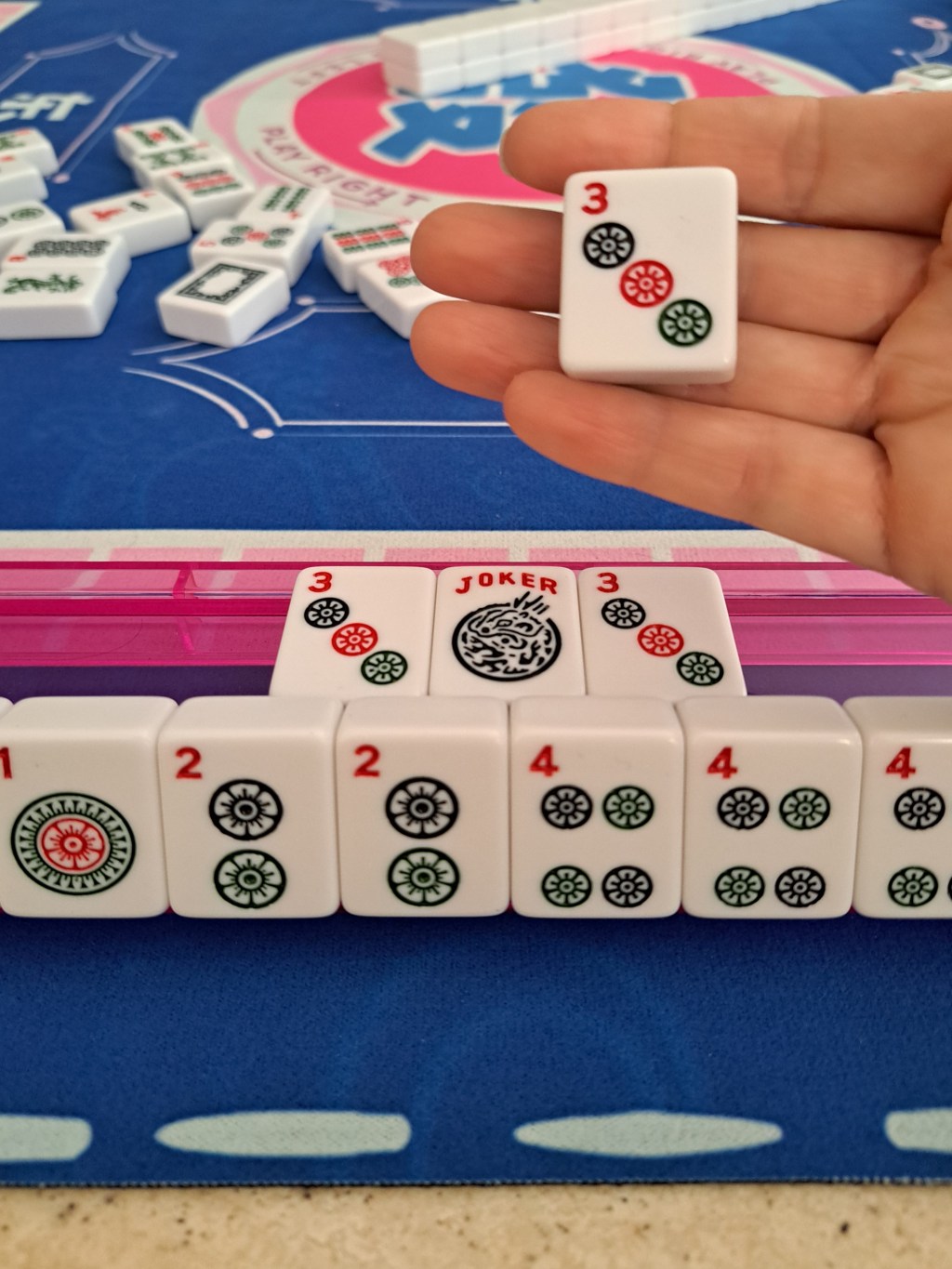
Learning how to add to or complete combinations in American Mahjong is key to mastering the game. Whether you’re playing a casual round or diving into a more competitive setting, knowing when and how to call tiles, make exposures, and correct mistakes can make all the difference.
Let’s break it down step-by-step so you can play with confidence!
What Does It Mean to Complete a Combination?
In American Mahjong, the goal is to build a hand that matches one of the combinations (or “hands”) on the National Mah Jongg League (NMJL) card. These combinations can include:
- Pairs (two matching tiles)
- Pungs (three of a kind)
- Kongs (four of a kind)
- Quints (five of a kind)
To complete these, you’ll often need to add to your hand using tiles discarded by other players.
Pick or Call?
When it’s your turn, you’ll draw (or “pick”) a tile from the wall. If another player discards a tile that would help you complete a combination, you can call it—but only under certain conditions.
You May Call a Tile When:
- For a Kong or Quint: It may be worth calling the tile immediately—even if it’s the first discard of the game. Keep in mind, however, that the more tiles you expose, the easier it becomes for other players to narrow down which hand you’re building.
- For a Pung: You may want to wait and call on the second occurrence of the tile being discarded, or hope to draw it from the wall if it’s early in the game.
- For a Pair or Singles: You can only call for a pair or single tiles if it’s your Mahj tile—the final tile that completes your entire hand. NEWS and 2025 are groups of singles and not a kong.
Making an Exposure
When you call a tile to complete a combination, you must expose that set face-up on the top of your rack.
Here’s how it works:
- If you have two matching tiles in your hand (e.g., 2 Bams) and another player discards a third, you can call it to complete a Pung and place all three tiles face-up on your rack.
- Exposures must match the hand you’re playing from the NMJL card exactly.
Important Guidelines for Exposures
- You may adjust or rearrange your exposure until you make your discard.
- Once you discard, the exposure is final and cannot be changed for the rest of the round.
- If you later draw a fourth tile that matches an exposed Pung, you cannot add it to make a Kong—once a set is exposed as a Pung, it must stay a Pung.
- However, if the Pung includes a joker, you may exchange your natural tile for the joker. Then you can either:
- Place the joker on the slope of your rack to use in another combination, or
- Discard the joker if you can’t use it, or if you’re playing a jokerless hand.
- Place the joker on the slope of your rack to use in another combination, or
- When making an exposure with jokers, it’s smart to place the joker between two matching natural tiles (e.g., 3 Dot – Joker – 3 Dot). This helps prevent accidental or incorrect joker exchanges by other players.
While one exposure may not tell which hand is being played, two exposures may reveal the hand or possible hands.
Tip: Not every hand allows exposures—some are concealed!
Calling for Concealed Hands
Certain hands on the NMJL card are labeled as C (Concealed)—these must be completed entirely from tiles you draw yourself, except the final tile to declare Mahjong.
You cannot call for combinations in these hands.
You can only call your final tile to go Mahjong.
Trying to call a tile mid-hand for a concealed hand is a common beginner mistake.
Correcting an Incorrect Exposure
If you make an incorrect exposure (for example, exposing a Kong when the hand only allows a Pung), the hand may be dead—meaning you’re no longer eligible to win that round unless you can change your hand.
To avoid this:
- Double-check your NMJL card before calling or exposing.
- Practice reading hand patterns and symbols (even experienced players slip up!).
Final Thoughts
Calling, exposing, and completing combinations are central to American Mahjong—but so is strategy. Don’t rush to expose if you’re still unsure which hand you’re going for. Sometimes it’s smarter to wait and confirm the hand you want to play.
Remember:
- Pick on your turn.
- Call only when it fits your hand AND the rules.
- Expose carefully.
- Keep concealed hands hidden (except for Mahj).
- Correct mistakes early to keep learning and improving.
With practice, you’ll start to recognize patterns faster and know exactly when to call and when to wait.
Want to learn more? Join one of our beginner-friendly Mahjong classes where we break it all down—tiles, strategy, etiquette, and fun!
Stay Connected with Mahj Mind
Got a question or idea? Email us: MahjMind@gmail.com
Join the community: Mahj Mind AZ Facebook Group

Leave a comment