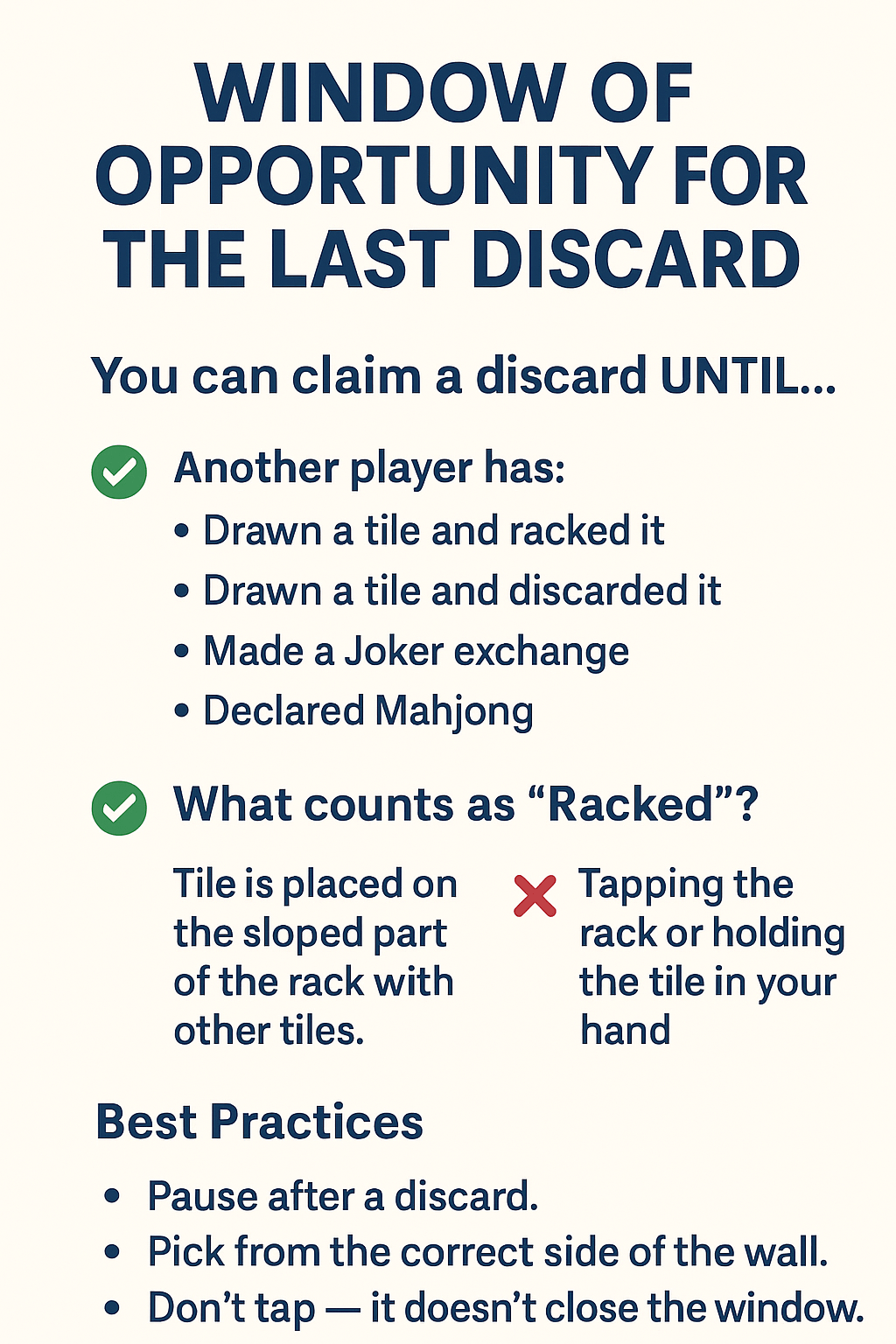
One of the trickiest and most often debated topics in American Mahjong is the window of opportunity for claiming the last discard. When exactly does that window close? The answer depends on what the next player has done with their pick. Let’s break it down.
Official NMJL Rules on Claiming a Discard
According to the National Mah Jongg League (Mah Jongg Made Easy, 2024, Rules & Penalties p. 17):
A player shall not be permitted to call a tile for an exposure or Mah Jongg:
- After the player to the right of the discarder has drawn a tile from the wall and racked or discarded.
- If another player is making a Joker exchange.
- If another player has declared Mahjong.
A “racked” tile is clearly defined: it must be placed on the sloped part of the rack with the rest of a player’s tiles. Simply tapping the rack with a tile or standing it on the card does not count as racking.
Common Question: Can You Still Call a Discard If the Next Player Has Drawn?
Q: If a player has drawn a tile but not racked it yet, can the previous discard still be called?
A: Yes. The window of opportunity stays open until the tile is racked or discarded. That means:
- Looking at the tile while holding it in your hand (or even next to the rack) does not close the window.
- Once it’s actually racked or discarded, the window closes.
Why the Definition of “Racked” in Mahjong Matters
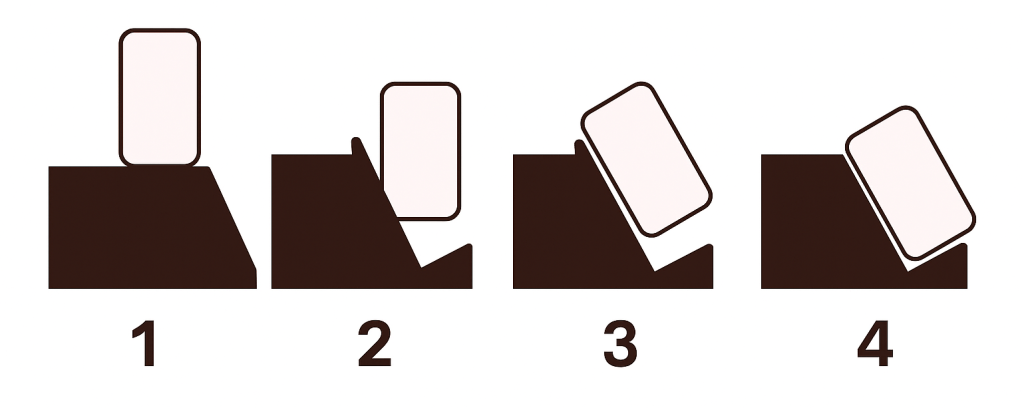
The definition of “racked” may seem straightforward, but in practice, disagreements often pop up. Here are the common positions:
- Position 1 (near the slope of the rack): Some say this is racked, but most disagree.
- Position 2 or 3 (touching the slope of the rack): Opinions differ; some claim this closes the window, others say it doesn’t.
- Position 4 (tile fully on sloped rack): Everyone agrees, this is racked.
Because the rules hinge on this definition, clarity is key. When in doubt, stick with the NMJL definition: a tile is racked only once it is placed with the other tiles on the sloped rack.
Best Practices for Fair Play in American Mahjong
Pause after a discard. Always allow time for other players to call the tile before you reach for the wall. With beginners, a good habit is to count to three silently. With experienced players, wait until the discarder has removed their hand from the tile and pulled it back off the table.
Pick from the correct side of the wall. When you draw, be mindful. Looking at the tile in your hand (without racking it) keeps the discard window open for others. If you look at the tile while pulling it back from the center of the table, be careful — other players may catch a glimpse.
Rack, discard, or declare Mahjong. If you are more than one tile away from Mahjong, rack your tile before making your discard. If you are on your final tile, you may choose not to rack for speed, but be aware that this can signal to others that you’re close to completing your hand, and they may adjust their play defensively.
Avoid tapping. Tapping the rack with a tile does not count as racking. Don’t assume it closes the window of opportunity.
Respect the call. Any verbal claim (“call,” “I want that,” or even “wait!”) must be honored as long as it is made before the window of opportunity closes.
Key Takeaway: When Does the Window of Opportunity Close?
The window of opportunity is a crucial piece of Mahjong etiquette and fairness. It closes only once the next player has racked or discarded their drawn tile — not when they tap, hover, or handle it.
So next time you’re at the table, remember: pause for a beat, respect the call, and keep playing fair. After all, Mahjong is about skill, strategy, and courtesy.
Sources:
Mah Jongg Made Easy, 2024, Rules & Penalties p. 17
WINDOW OF OPPORTUNITY FOR THE LAST DISCARD (Article 107)
Stay Connected with Mahj Mind
Got a question or idea? Email us: MahjMind@gmail.comJoin the community: Mahj Mind AZ Facebook Group

Leave a comment