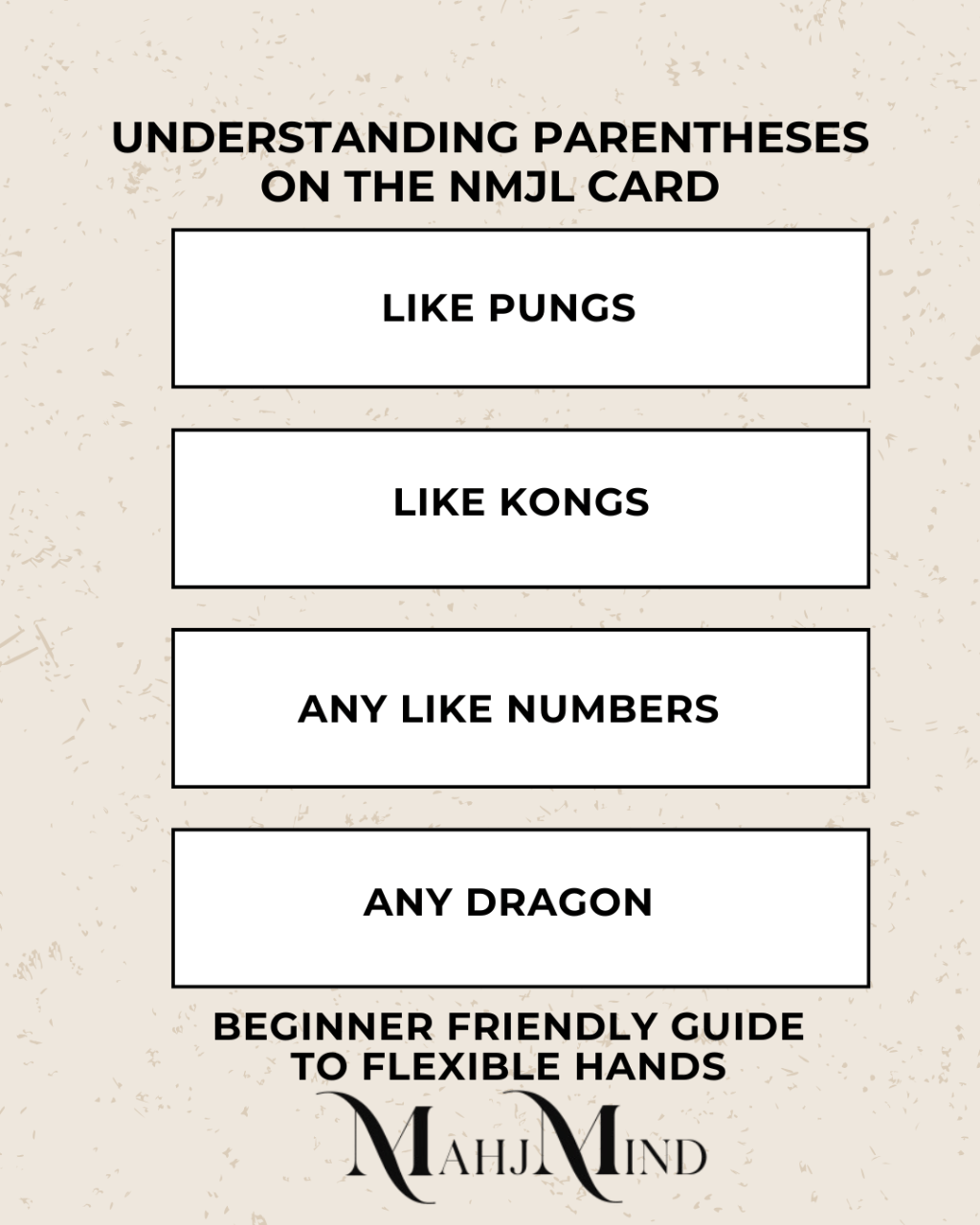
If you’ve ever stared at the NMJL card and wondered what the parentheses actually mean, you’re not alone. This is one of the most common areas of confusion I see in beginner American Mahjong classes. The fine print can feel overwhelming, especially when you’re brand new to American Mahjong or learning how to navigate a fresh card each year.
Here’s the good news:
Parentheses exist to show you where the card gives you flexibility.
Understanding that flexibility will make you a more confident, strategic, and intuitive player.
One of the best ways to learn these patterns is by physically building the hands with tiles on your rack. Seeing the structure in front of you helps you truly understand how the patterns work.
Below is a clear walkthrough from different categories and examples of how parentheses guide your options.
2025 Category
Hand:
FFFF 2025 222 222

- In this hand, you have flexibility in the two pungs of numbers.
- You may use like pungs (groups of 3) of 2s or like pungs of 5s
- They must be in opposite suits, but you decide which number appears twice.
2468 Category: Any Even Numbers Welcome
In these 2468 hands, parentheses indicate that any even numbers may be used to complete the pungs or kongs.
Examples:



FFFF 2468 222 222



FF 2222 DDDD 2222



22 44 66 88 222 222
As long as the hand stays in an even-number pattern, the specific digits are flexible.
Any Like Numbers: The Number Is Your Choice



Although these hands are printed using 1s, they are simply placeholders.
As long as all blocks match you may use any number—2s, 5s, 8s, etc.
Flexibility in Quints





You may use:
- Any consecutive numbers in the first or second hand
- Any wind in the second hand
This makes Quints ideal for players who pick up multiple jokers and want a higher-value hand with fewer restrictions.
Consecutive Runs: Understanding What Is and Isn’t Allowed
Many beginners start by learning the Consecutive Run category because it appears straightforward. You quickly learn how numbers move in order, but this is also where confusion sometimes occurs.
A misconception that I sometimes see is the belief that you can start with high numbers like 6-7-8-9 and loop back around to 1, or use soaps as zeroes.
This is not allowed.
The run must be linear, and soaps do not act as zeroes in consecutive runs.
The second line from the bottom often confuses new players. The kongs must match the pair of the numbers in the five-number run, and because it’s a “floating pair,” it can be placed in any position within that run.



Example:
112345 1111 1111
Just remember: the kongs (groups of 4) must match the pair you choose.
Winds and Dragons: Suit Flexibility You Might Miss



Example:
FF 123 DD DDD DDDD
The dragons used in the kong do not need to match the suit of the three consecutive numbers. As long as the hand structure matches the card, your dragon suit choice is open.




Example:
NNNN 1 11 111 SSSSS
Any odd number works, as long as all three number groupings match.



Example:
EEEE 2 22 222 WWWW
The same applies with an even number; they all must match each other.



Example:
NN EE WWW SS DDDD
The dragons may be any dragons for the kong, but must match each other.
369 Category:
Line 5 tells you that you may use any of the numbers 3, 6, or 9 to form the kongs.


Example:
33 66 99 3333 3333
Singles and Pairs: A Bit of Flexibility Within the Structure
These hands require three suits, but you have choice in the final pair:


3366999 336699 33
The last pair may be 3s, 6s, or 9s.




11 33 55 77 99 11 11
The paired numbers may be any like odd numbers in opposite suits, in the final two pairs.
Hands With Limited Flexibility
The majority of hands give suit flexibility but restrict the numerical choices. For example, the first line in the Consecutive Run category includes:


“These Numbers Only.”
This means the numbers shown must be used exactly as printed.
Final Thoughts: Let Parentheses Help You Play Smarter
Understanding what the parentheses on the NMJL card mean can transform the card from something intimidating into a helpful strategic guide.
They show you:
- Where you have choices
- Where structure must remain fixed
- How to adapt based on the tiles you’re dealt
The more you practice building the hands, the more natural these patterns will feel—and the faster your game confidence will grow.
Source: 2025 NMJL Card
Online Coaching
You’ll get individualized guidance that will help build confidence and clarity.
Whether you’re brand new or ready to refine your strategy, this coaching experience meets you where you are. Every session is personalized, supportive, and rooted in a growth mindset because Mahjong is more than a game.
Book a time that works for you, settle in with your card, I Love Mahj, and Zoom. (Tiles optional.) Let’s build your skills step by step.

Stay Connected with Mahj Mind
Email us: MahjMind@gmail.com
Join the community: Mahj Mind AZ Facebook Group

Leave a comment